Wednesday, January 11, 2023

#17 Mike Marshall - Seattle Pilots


Michael Grant Marshall
Seattle Pilots
Pitcher

Bats:
  Right  Throws:  Right  Height:  5'10"  Weight:  180
Born:  January 15, 1943, Adrian, MI
Signed:  Signed by the Philadelphia Phillies as an amateur free agent, September 13, 1960
Major League Teams:  Detroit Tigers 1967; Seattle Pilots 1969; Houston Astros 1970; Montreal Expos 1970-1973; Los Angeles Dodgers 1974-1976; Atlanta Braves 1976-1977; Texas Rangers 1977; Minnesota Twins 1978-1980; New York Mets 1981
World Series Appearances:  Los Angeles Dodgers 1974
Died:  May 31, 2021, Zephyrhills, FL (age 78)
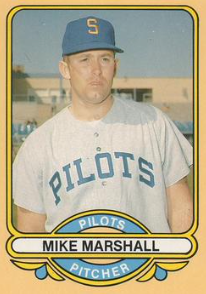
1983 Galasso
1969 Seattle Pilots #6
Relying on a nearly unhittable screwball, Mike Marshall played for nine different teams over 14 seasons, but he's best remembered as a successful reliever for the Dodgers between 1974 and 1976, and as the first relief pitcher to win the Cy Young Award in 1974.  Marshall didn't find much success in the early part of his career, despite a strong rookie campaign with the Tigers in 1967 when he had a 1.98 ERA over 37 relief appearances.  He bounced around a bit before assuming the closer role for the Expos in 1971.  He'd lead the league in games finished for four straight seasons beginning that year.  With the Expos in 1973 and the pennant-winning Dodgers in 1974, he'd lead the league with 31 and 21 saves, respectively.  Marshall appeared in a career-high, league leading 106 games in 1974, pitching 208 1/3 innings in relief and was 15-12 with a 2.42 ERA on the way to his Cy Young win.  He was also an All-Star in 1974 and 1975. 

Over the next six seasons, and somewhat due to having a difficult personality, Marshall spent time with the Braves, Rangers, Twins and Mets, once again leading the league in appearances and saves in 1979 when he entered 90 games for the Twins and notched 32 saves.  

For his career, Marshall was 97-112 with a 3.14 ERA in 724 games pitched, recording 188 saves, which is currently 59th on the all-time list.  Known for his quirkiness and his opinionated nature, Marshall often backed up his arguments with science, having earned his Ph.D. in kinesiology, the study of bone mechanics, from Michigan State University.

Building the Set / 
Card #8
December 4, 2021 from The Philly Show (Uncle Dick's Cards, Babylon, NY)
I've posted a complete summary of this fantastic show over at The Phillies Room, and this was one of six cards from the 1969 Topps set I added to our stack of 1965 Topps commons, almost as an afterthought.  In total, I added 94 cards to our 1965 Topps set from Uncle Dick's and his neon green binders, six cards from the 1969 Topps set and two more from the 1959 Topps set for a future set build.  After a dealer discount, this Marshall card was $1.50.  Composing posts for these six cards will take much less time than it took to compose posts for the 94 cards added to our 1965 Topps set.

The Card / Pilots Team Set / Accuracy Index -8
For the first Pilots card in the set, Marshall is shown wearing a Tigers jersey in Yankee Stadium, in a photo from the same session that gave Topps the picture used for his 1968 Topps rookie card.  Topps left the cartoon tiger on the back of the card, despite Marshall having moved on to the Pilots.  The start of his professional career within the Phillies system (see below) is discussed, and there's an uncorrected error with the word mound misspelled as "mount."

Accuracy Index:  This card gets a -8 (minus five for the Tigers uniform, and minus three since Marshall is hatless) which could be considered a harsh grade given the Pilots were a new expansion team.

1969 Season
Marshall was left unprotected by the Tigers and selected by the Pilots as the 53rd pick in the 1968 expansion draft.  He made the club's opening day roster and the starting pitching rotation, starting the second game in Pilots' team history following Marty Pattin's (#563) opening day start.  Marshall was 3-10 with a 5.13 ERA in 20 games, including 14 starts, throwing 87 2/3 innings.  He made his final appearance with the Pilots on July 5th and then somehow spent the remainder of the season pitching for the Toledo Mud Hens, the Tigers' Triple-A affiliate and the team he had pitched with for the entire 1968 season.  Marshall was 6-4 with a 3.10 ERA in 11 starts for the Mud Hens.  On November 21st, he was sold to the Astros.

Phillies Connection
The Phillies signed Marshall as a shortstop in September 1960, and he struggled mightily in the field, committing 205 errors at four different stops in the Phillies' minor league system between 1961 and 1964.  He decided to convert to pitching in 1965, appearing in 44 games and going 8-9 with a 3.39 ERA in 85 innings for the Phillies' single-A and AA teams.  Having seen enough of Marshall, and convinced he would never make it as a pitcher, the Phillies sold him to the Tigers on April 11, 1966.

1968 Topps #201
1972 Topps #505
1974 Topps #73
1975 Topps #330
1977 Topps #263

Other Notable Baseball Cards

First Mainstream Card:  1968 Topps #201
Topps Flagship Set Appearances (9):  1968-1969, 1971-1977
Most Recent Mainstream Card:  1983 Galasso 1969 Seattle Pilots #6
Total Non-Parallel Baseball Cards:  67 in the Beckett online database as of 12/28/22.

Sources:  
Baseball Reference / SABR / Wikipedia

Monday, January 9, 2023

#14 Al McBean - San Diego Padres


Alvin O'Neal McBean
San Diego Padres

Pitcher

Bats:
  Right  Throws:  Right  Height:  5'11"  Weight:  165
Born:  May 15, 1938, Charlotte Amalie, U.S. Virgin Islands
Signed:  Signed by the Pittsburgh Pirates as an amateur free agent before 1958 season
Major League Teams:  Pittsburgh Pirates 1961-1968; San Diego Padres 1969; Los Angeles Dodgers 1969-1970; Pittsburgh Pirates 1970

One of the top relievers of the early 1960s, Al McBean was the first pitcher in the majors born in the U.S. Virgin Islands.  For three seasons, from 1963 to 1965, McBean placed in the top ten among N.L. pitchers for saves and appearances.  He enjoyed his best season in 1964, recording a career high 21 saves and being named The Sporting News' N.L. Fireman of the Year.  He recorded 19 saves the following year but then the Pirates returned their closer duties to Roy Face (#207), coming back from an injury, in 1966. 

McBean was a popular, fun-loving player with a somewhat quirky personality.  The best man at his wedding in 1962 was his Pirates' roommate Roberto Clemente (#50).  In parts of 10 seasons, McBean appeared in 409 games (76 starts), compiling a 67-50 record and a 3.13 ERA with 63 saves.  For years following his playing days he remained active within his community in St. Thomas.

Some text for this post originally appeared on my 1965 Topps blog.

Building the Set / 
Card #7
December 4, 2021 from The Philly Show (Uncle Dick's Cards, Babylon, NY)
I've posted a complete summary of this fantastic show over at The Phillies Room, and this was one of six cards from the 1969 Topps set I added to our stack of 1965 Topps commons, almost as an afterthought.  In total, I added 94 cards to our 1965 Topps set from Uncle Dick's and his neon green binders, six cards from the 1969 Topps set and two more from the 1959 Topps set for a future set build.  After a dealer discount, this McBean card was about $1.  Composing posts for these six cards will take much less time than it took to compose posts for the 94 cards added to our 1965 Topps set.

The Card / Padres Team Set / Accuracy Index -8
This is the first card of the expansion Padres in the set, and therefore technically the first ever Padres baseball card.  McBean is shown here in a Pirates uniform, with the photo taken during the same session that yielded the photo used for his 1968 Topps card.  His 1964 Fireman of the Year honors are highlighted on the back and his grand slam from July 28, 1968 is also mentioned.  McBean hit the home run off Cardinals' pitcher Larry Jaster (#496).

Accuracy Index:  McBean loses five points for being pictured in a Pirates uniform and three points for being hatless.

1969 Season
McBean was drafted by the Padres from the Pirates as the 50th pick in the 1968 expansion draft.  Beginning the season as the new club's fifth starter behind Dick Selma (#197), Johnny Podres (#659), Dick Kelley (#359) and Clay Kirby (#637), McBean made only one start for the Padres on April 12th against the Giants.  He took the loss after allowing four runs on 10 hits over seven innings of work.  On April 17th, the Padres traded McBean to the Dodgers for Tommy Dean (#641) and Leon Everett.  With Los Angeles, he made 31 relief appearances, going 2-6 with a 3.91 ERA in 48 1/3 inning pitched.

Phillies Connection
McBean was released by the Pirates (his second stint with the club) on May 18, 1970 and signed with the Phillies.  In 1970 and 1971, he appeared in 32 games for the Triple-A Eugene Emeralds, managed by former Phillies catcher Andy Seminick.  McBean went 13-9 with a 4.82 ERA over 190 innings pitched, but he never got the call from the Phillies.  He retired following the 1971 season.

1962 Topps #424
1964 Topps #525
1967 Topps #203
1968 Topps #514
1970 Topps #641

Other Notable Baseball Cards

First Mainstream Card:  1962 Topps #424
Topps Flagship Set Appearances (9):  1962-1970
Most Recent Mainstream Card:  1981 TCMA The 1960s II #435
Total Non-Parallel Baseball Cards:  42 in the Beckett online database as of 12/28/22.

Sources:  
Baseball Reference / SABR / Wikipedia

Saturday, January 7, 2023

#151 Clay Dalrymple - Philadelphia Phillies


Clayton Errol Dalrymple
Philadelphia Phillies
Catcher

Bats:  Left  Throws:  Right  Height:  6'0"  Weight:  195
Born:  December 3, 1936, Chico, CA
Acquired:  Obtained by the Milwaukee Braves from the Sacramento Solons (PCL) as part of a minor league working agreement
Major League Teams:  Philadelphia Phillies 1960-1968; Baltimore Orioles 1969-1971
World Series Appearances:  Baltimore Orioles 1969

1969 Topps #151 - Orioles
Clay Dalrymple was the regular catcher for the Phillies throughout much of the 1960s, earning the job due to his handling of the pitching staff and his above average defensive skills.  Dalrymple led all catchers in assists and runners caught stealing in three different seasons (1961, 1963 and 1965).  He peaked offensively with the Phillies in 1962, hitting career highs with a .276 average, 11 home runs and 54 RBIs.  Dalrymple led the league with eight sacrifice flies in 1964, and had a front row seat for the team's collapse in September.  He was behind the plate on September 21, 1964 when Chico Ruiz (#469) stole home to give the Reds a 1-0 victory and begin the Phillies' 10-game losing streak.

Dalrymple saw his playing time decrease during his last few years with the Phillies, sharing catching duties with Pat Corrales (#382), Bob Uecker, Gene Oliver (#247) and finally Mike Ryan (#28).  A target of the Phillies' fans ire, Dalrymple requested a trade and was accommodated when the team sent him to the Orioles before the 1969 season.  Having come so close to the postseason in 1964, Dalrymple finally saw October action when the Orioles won the A.L. East pennant in 1969.  He was 2 for 2 with a pair of pinch-hit singles in the Series as the Orioles fell to the Mets in five games.  A broken ankle hobbled Dalrymple his final two years in the majors, and he retired following the 1971 season.

In 1,079 career games, Dalrymple batted .233 with 710 hits, 55 home runs and 327 RBIs.  For his career, Dalrymple ranks in the top 100 (98th) for double plays turned by a catcher with 79, and his 48.8% caught stealing percentage is currently 30th all-time.

Some text for this post originally appeared on my 1965 Topps blog.

Building the Set / Card #6
November 6, 2021 from Cooperstown, NY (Willis Monie Books)
Needing a quick vacation and wanting to take our sons to Cooperstown for the first time, we took advantage of the annual NJEA Teacher Convention in which public schools are closed for a few days in early November.  We loaded our car on Thursday morning with a loose plan of spending two days in Cooperstown and the surrounding area, shopping in the village, soaking in the Hall of Fame exhibits and eating a few good dinners.  The 4 1/2 hour drive to Otsego County was scenic and enjoyable.  Most of the day Friday was spent in the Hall of Fame and Saturday was dedicated largely to shopping in the many stores, mostly baseball related, located in the blocks surrounding the Hall.

Having spent Saturday morning in the Hall and then having lunch again at Doubleday Cafe, we walked down Main Street one more time to see if there were any stores we had missed.  There was an old book store towards the end of Main Street and with some time to kill, I decided to have a look around.  Willis Monie Books has to be seen to be believed.  Thousands upon thousands of books dating back a few centuries to recent releases are haphazardly (but lovingly) stacked and piled and balanced among the multiple rows, aisles and nooks of this store.  In the foyer, outside the front door, I found an out of service rotating display case with old baseball cards in it and on top of that case were more stacks of books and a few 800-count boxes of loosely organized cards from the 1950s, 1960s and 1970s.  I probably spent well over a half hour pouring through the boxes, coming away with nine cards total from 1959, 1965 and 1969 and spending a grand total of $20.  This Dalrymple card was the only card I found for our not-yet-collecting 1969 Topps set, and it set me back $2.

The Card / Phillies Team Set / Accuracy Index -7
This is the first of two Dalrymple cards I'll be adding to our set, as the second is a variation showing him hatless and with the Orioles.  Topps made the unusual move in 1969 of updating both Dalrymple and Donn Clendenon's (#208) cards to show them with their newer teams.  The cartoon on the back is identical on both variations, but Topps updated the write-up on the Orioles version to mention Dalrymple's trade to Baltimore that January.

Accuracy Index:  Dalrymple's Phillies card scores a 3 - plus 5 points for the accurate Phillies uniform, but then minus 2 for featuring him on a team for which he didn't appear in 1969.

Update:  I'm updating this score.  Dalrymple drops to a -7, since he's wearing his former team's uniform (-5) and he's shown with a team he didn't play for in 1969 (-2).

1969 Season
The Phillies dealt Dalrymple to the Orioles on January 20, 1969, receiving outfielder Ron Stone (#576) in return.  Dalrymple was third on the Orioles' catching depth chart behind Elrod Hendricks (#277) and Andy Etchebarren (#634), appearing in only 37 games and making 23 starts behind the plate for the eventual American League pennant winners.

Phillies Career
Dalrymple played in the Braves' organization for the 1959 season, and was left unprotected in that offseason's rule 5 draft.  Selected by the Phillies in the draft on November 30, 1959, Dalrymple began the 1960 season as back-up to regular catcher Jimmie Coker.  He'd take over the position full-time in 1961, making the first of five opening day starts behind the plate, with his streak broken in 1966 by Uecker.  As mentioned above, he assumed a part-time role with the club beginning in 1966, and was dealt to the Orioles in January 1969.  In 1,006 games with the Phillies over nine seasons, Dalrymple batted .234, collecting 674 hits.

1960 Topps #523
1962 Topps #434
1964 Topps #191
1968 Topps #567
1971 Topps #617

Other Notable Baseball Cards

First Mainstream Card:  1960 Leaf #143
Topps Flagship Set Appearances (12):  1960-1971
Most Recent Mainstream Card:  2020 Topps Heritage Real One Autographs #ROA-CD
Total Non-Parallel Baseball Cards:  71 in the Beckett online database as of 12/28/22.

Sources:  
Baseball Reference / SABR / Wikipedia

Thursday, January 5, 2023

#75 Luis Aparicio - Chicago White Sox


Luis Ernesto Aparicio
Chicago White Sox
Shortstop

Bats:  Right  Throws:  Right  Height:  5'9"  Weight:  160
Born:  April 29, 1934, Maracaibo, Venezuela
Signed:  Signed by the Chicago White Sox as an amateur free agent before 1954 season
Major League Teams:  Chicago White Sox 1956-1962; Baltimore Orioles 1963-1967; Chicago White Sox 1968-1970; Boston Red Sox 1971-1973
World Series Appearances:  Chicago White Sox 1959; Baltimore Orioles 1966
Hall of Fame Induction:  1984

Known for his exceptional defense and base running skills, Luis Aparicio played for 18 seasons in the majors, primarily for the White Sox.  Ted Williams (#650) called him "the best shortstop he had ever seen."  Aparicio made his debut in 1956, winning the American League Rookie of the Year honors after batting .266 and leading the league with 21 stolen bases.  It was to be the first of nine straight years in which Aparicio led the league or tied for the league lead in stolen bases, and he eclipsed the 50 stolen base
1968 Topps #310
mark in four of those seasons.  Aparicio helped lead his "Go-Go" White Sox to the World Series in 1959, and he was American League MVP runner-up.  Dealt to the Orioles before the 1963 season, Aparicio's production declined slightly but his defensive skills didn't.  He reunited with the White Sox in 1968 and enjoyed a late career resurgence making three more All-Star teams in his late 30s with the White Sox and Red Sox.

Aparicio retired with 2,677 career hits, 506 stolen bases (currently 38th all-time) and a .262 lifetime average.  Upon his retirement, he was the all-time leader for hits, games played, assists and double plays by a shortstop, and his record nine Gold Gloves was matched by Omar Vizquel in 2001.  Derek Jeter broke his all-time hits record by a shortstop in 2009.  Aparicio was the first native Venezuelan inducted into the Hall of Fame in 1984, and his #11 was retired by the White Sox that same year.

Some text from this post originally appeared on my 1965 Topps blog.

Building the Set / Card #4
November 6, 2021 from Cooperstown, NY (Seventh Inning Stretch)
In early November 2021, needing a quick vacation and wanting to take our sons to Cooperstown for the first time, we took advantage of the annual NJEA Teacher Convention in which public schools are closed for a few days.  We loaded our car on a Thursday morning with a loose plan of spending two days in Cooperstown and the surrounding area over the weekend, shopping in the village, soaking in the Hall of Fame exhibits and eating a few good dinners.  The 4 1/2 hour drive to Otsego County was scenic and enjoyable.  Most of the day Friday was spent in the Hall of Fame and Saturday was dedicated largely to shopping in the many stores, mostly baseball related, located in the blocks surrounding the Hall.

We had spent a little bit of time in the multi-level Seventh Inning Stretch, located adjacent to Doubleday Field, on Friday.  But on Saturday I wanted to dig in to their haphazard, loosely alphabetical, collection of baseball cards for sale on their second floor.  I spent close to 45 minutes going through the boxes, and this card was one of about a dozen cards I picked out among the glorious mess of cards covering all eras between early 20th Century the late 2010s.  This card cost $6 and was one of a pair of cards, along with the Ted Shows How card (#539), added to our not-yet-collecting 1969 Topps set.  We also added one card to my 1935 Diamond Stars set and a few low-priced cards for our future 1959 Topps set.

The Card / White Sox Team Set / Accuracy Index -12
Topps recycled the photo used for Aparicio's 1968 card here, featuring the shortstop hatless and wearing an Orioles jersey.  The cartoon on the back of the card highlights the nine years in a row Aparicio led the league in stolen bases.  The 6-man deal Topps references happened on November 29, 1967 with Aparicio, John Matias and Russ Snyder (#201) going to the White Sox, and Don Buford (#478), Bruce Howard (#226) and Roger Nelson (#279) heading to Baltimore.

Accuracy Index:  Aparicio's card scores a -12 for featuring him in an old uniform (-5), hatless (-3) and using a picture we've seen before (-4).
Inserts:  He's included in the 35 card Topps Deckle Edge insert set and is one of 48 decals in the Topps Decals insert set.  His Deckle Edge card features him in an Orioles uniform too, but Topps has added a SOX logo to his batting helmet.  Aparicio is one of 27 players to appear in both insert sets.


1969 Season
Traded back to the White Sox following the 1967 season as mentioned above, Aparicio was settling into his second full season in his reunion with his original team.  While the White Sox were not a good team in 1969, finishing with a 68-94 record and costing Al Lopez (#527) his job, Aparicio was the team's MVP.  In 156 games as every day shortstop, he batted .280 with 24 doubles, 51 RBIs and 24 stolen bases.  He collected his 2,000 career hit on May 15th off Tigers' pitcher Earl Wilson (#525).

1956 Topps #292
1959 Topps #310
1962 Topps #325
1970 Topps #315
1974 Topps #61

Other Notable Baseball Cards

First Mainstream Card:  1956 Topps #292
Topps Flagship Set Appearances (19):  1956-1974
Most Recent Mainstream Card:  2021 Topps 206 (Wave 8)
Total Non-Parallel Baseball Cards:  1,010 in the Beckett online database as of 12/27/22.

Sources:  
Baseball Reference / SABR / Wikipedia
National Baseball Hall of Fame

Wednesday, January 4, 2023

#539 Ted Shows How - Mike Epstein / Ted Williams CPC


In the set's sixth series, Topps made the decision to include four (and only four) combo cards featuring members of the Orioles, Senators, Athletics and Giants.  A staple throughout the prior decade-plus of Topps sets, the combo cards would make a brief, final appearance with these four cards and then disappear again.  Various checklists also denote these as "CPC" for combo player cards.

Building the Set / 
Card #4
November 6, 2021 from Cooperstown, NY (Seventh Inning Stretch)
In early November 2021, needing a quick vacation and wanting to take our sons to Cooperstown for the first time, we took advantage of the annual NJEA Teacher Convention in which public schools are closed for a few days.  We loaded our car on a Thursday morning with a loose plan of spending two days in Cooperstown and the surrounding area over the weekend, shopping in the village, soaking in the Hall of Fame exhibits and eating a few good dinners.  The 4 1/2 hour drive to Otsego County was scenic and enjoyable.  Most of the day Friday was spent in the Hall of Fame and Saturday was dedicated largely to shopping in the many stores, mostly baseball related, located in the blocks surrounding the Hall.

We had spent a little bit of time in the multi-level Seventh Inning Stretch, located adjacent to Doubleday Field, on Friday.  But on Saturday I wanted to dig in to their haphazard, loosely alphabetical, collection of baseball cards for sale on their second floor.  I spent close to 45 minutes going through the boxes, and this card was one of about a dozen cards I picked out among the glorious mess of cards covering all eras between early 20th Century the late 2010s.  This card cost $12 and was one of a pair of cards, along with Luis Aparico (#75), added to our not-yet-collecting 1969 Topps set.  We also added one card to my 1935 Diamond Stars set and a few low-priced cards for our future 1959 Topps set.

The Card / Senators Team Set
Ted Williams (#650) was named the Senators manager prior to the 1969 season, taking over for Jim Lemon (#294) who had been let go following the team's 10th place finish the prior season.  

Williams seems to be showing Mike Epstein (#461) how to choke up on the bat in this photo taken at the Senators spring training facility in early 1969.  The back of the card summarizes Williams' career highlights and mentions the hope the team had of Epstein following in Williams' steps. 

1969 Season
Williams guided the club to a record of 86-76 in 1969, winning Manager of the Year honors for his efforts.  It was the only winning season of the franchise's brief 11-year stay in Washington, and they would relocate to Arlington in 1972, rechristened as the Texas Rangers.  Epstein was the Senators' regular first baseman, making 115 starts at the position and appearing in 131 games overall.  He batted .278 with 30 home runs and 85 RBIs, one of his best seasons in the majors.

Sources:  
Baseball Reference / Wikipedia

#538 Charlie Smith - Chicago Cubs#540 Curt Flood - St. Louis Cardinals

Monday, January 2, 2023

#507 Cookie Rojas - Philadelphia Phillies


Octavio Victor Rojas
Philadelphia Phillies
Infield-Outfield

Bats:  Right  Throws:  Right  Height:  5'10"  Weight:  160
Born:  March 6, 1939, La Habana, Cuba
Signed:  Signed by the Cincinnati Reds as an amateur free agent before 1956 season
Major League Teams:  Cincinnati Reds 1962; Philadelphia Phillies 1963-1969; St. Louis Cardinals 1970; Kansas City Royals 1970-1977
As a Manager:  California Angels 1988; Florida Marlins 1996

A long-time utility player for the Phillies, Cookie Rojas enjoyed the best years of his career as the starting second baseman for the Royals in the early 1970s.  Rojas was a five time All-Star - once with the Phillies in 1965 and then four times with the Royals between 1971 and 1974.  Blocked at second base by Tony Taylor (#108) early in his career, Rojas moved around the field playing wherever needed for Phillies manager Gene Mauch (#606).  He finished in the top 10 in singles in his respective league in 1965, 1966 and 1974.  Rojas is second on the Royals' all-time games played list at second base behind Frank White.

Rojas played for 16 seasons, accumulating a .263 average over 1,822 games.  Following his playing career, Rojas stayed in the game serving as a coach for the Cubs between 1978 and 1981, and becoming the first Cuban born manager in major league history when he was at the helm for the Angels in 1988, succeeding his former manager Mauch as manager of that club.  He later served as a coach for the Marlins (1993-1996), Mets (1997-2000) and Blue Jays (2001-2002).  He's been the Spanish-language color commentator on Marlins television broadcasts since 2003.

Some text for this post originally appeared on my 1965 Topps blog.

Building the Set / 
Card #3
November 6, 2021 from Cooperstown, NY (Stonehouse Toys of Fame)
In early November 2021, needing a quick vacation and wanting to take our sons to Cooperstown for the first time, we took advantage of the annual NJEA Teacher Convention in which public schools are closed for a few days.  We loaded our car on a Thursday morning with a loose plan of spending two days in Cooperstown and the surrounding area over the weekend, shopping in the village, soaking in the Hall of Fame exhibits and eating a few good dinners.  The 4 1/2 hour drive to Otsego County was scenic and enjoyable.  Most of the day Friday was spent in the Hall of Fame and Saturday was dedicated largely to shopping in the many stores, mostly baseball related, located in the blocks surrounding the Hall.

We'd add nine cards to our 1965 Topps set during the weekend and four cards to our not-yet-collecting 1969 Topps set.  This Rojas card was pulled from a stack of loosely organized vintage Topps commons found within the subterranean Stonehouse Toys of Fame and it cost me $3.  I hadn't planned on adding any 1969 Topps cards during this trip, but by the end of the weekend Rojas would be joined by three other cards from the set.  It's fitting Rojas would be the first official card purchased for our 1969 Topps set build, as his 1965 Topps card was one of the first five cards we purchased for that set in December 2019.

The Card / Phillies Team Set / Accuracy Index +5
Given the card comes late in the set, I'm going to assume this is one of the newer photos to appear, perhaps taken as late as spring training 1969.  The back of the card highlights Rojas' 14-game hitting streak in 1968 which came in May and early June.  Rojas' versatility is also mentioned, and through the 1968 season he had pitched in one game, caught in seven games, played a game at first base and played three games at third base.

Accuracy Index:  This card scores a +5 for showing Rojas on the correct team and not recycling an old photo.

1969 Season
This was to be Rojas' seventh and final season with the Phillies.  In 110 games, he batted .228, the fourth year in a row his average had declined.  Rojas made 96 starts overall, with 94 starts coming a second base and a pair of starts in April in left field.  Taylor gradually saw more playing time at second base as the season progressed, and by the end of the season the Phillies had decided to move ahead with young Denny Doyle as Rojas' permanent replacement for 1970.  As noted below, Rojas was shipped to the Cardinals on October 7, 1969 as part of a blockbuster seven-player deal.

Phillies Career
The Phillies acquired Rojas from the Reds on November 27, 1962 for reliever Jim Owens, and his Topps rookie card in the 1963 set shows him wearing a Reds uniform top.  He played for seven seasons with the Phillies, appearing in at least 100 games every year except his first in 1963.  His best season with the club was 1965 when Rojas was named to his first All-Star team, joining his teammates Dick Allen (#350) and Johnny Callison (#133).  He appeared in 142 games that year, and saw more time at second base than usual due to a season long slump endured by regular second baseman Taylor.  He also led the team with a .303 average, which placed him eighth overall in the league.

After several years of declining offensive output, the Phillies traded him in October 1969.  Rojas was one of the players included in the blockbuster deal between the Phillies and Cardinals that shipped Allen and Jerry Johnson (#253) to St. Louis in exchange for Curt Flood (#540), Tim McCarver (#475), Byron Browne and Joe Hoerner (#522).  (Flood never reported to the Phillies, but that's a story for another post.)

Rojas played in 880 games for the Phillies - the exact amount of games he played for the Royals.

1963 Topps #221
1968 Topps #39
1971 Topps #118
1975 Topps #169
1988 Topps Traded #97T

Other Notable Baseball Cards

First Mainstream Card:  1963 Topps #221
Topps Flagship Set Appearances (16):  1963-1977, 1988
Most Recent Mainstream Card:  2019 Topps Archives Fan Favorites Autographs #FFA-CR
Total Non-Parallel Baseball Cards:  90 in the Beckett online database as of 12/27/22.

Sources:  
Baseball Reference / SABR
Beckett Database / The Trading Card Database
1965 Topps Blog / The Phillies Room