Showing posts with label 1954. Show all posts

Monday, August 25, 2025

#650 Ted Williams MG - Washington Senators


Theodore Samuel Williams
Washington Senators
Manager
Bats:  Left  Throws:  Right  Height:  6'3"  Weight:  205
Born:  August 30, 1918, San Diego, CA
Signed:  Signed by the Boston Red Sox as an amateur free agent in 1936
Major League Teams:  Boston Red Sox 1939-42, 1946-60
World Series Appearances:  Boston Red Sox 1946
As a Manager:  Washington Senators 1969-71; Texas Rangers 1972
Died:  July 5, 2002, Inverness, FL (age 83)
Hall of Fame Induction:  1966

Known affectionately throughout his career as The Kid, Teddy Ballgame and the Splendid Splinter, Ted Williams is one of the greatest hitters of all-time.  Other than his rookie campaign of 1939, his years serving in World War II (1943-45) and his first year in Korea (1952), Williams was named to the American League All-Star team every year he was active, making the club 19 times, including both All-Star teams in 1959 and 1960.  The MVP in 1946 and 1949, Williams is the last player to hit over .400 in a single season when he hit .406 in 1941.  His Hall of Fame plaque notes he was named Player of the Decade for the 1950s.

Williams won six batting titles, and won the Triple Crown in both 1942 and 1947.  Along with his Triple Crown years, he led the league in home runs in 1941 and 1949, and in RBIs in 1939, 1941 and 1949.  In 2,292 major league games, Williams batted .344 with 521 home runs and 1,839 RBIs.  His career on-base percentage of .482 is still the all-time record, while his slugging percentage of .634 is second all-time.  Williams was inducted into the Hall of Fame in 1966, and came out of retirement in 1969 to manage the Senators.  When the Senators moved to Arlington, he was the first manager in Texas Rangers franchise history.  Williams had his #9 retired by the Red Sox and was named to the Major League Baseball All-Century Team in 1999.

Some text for this post originally appeared on my 1956 Topps blog.

Building the Set / 
Card #545
December 15, 2024 from The Philly Show (Rookie Cards & More)
On Sunday, December 15th, Doug and I attended the latest Philly Show, spaciously spread out inside Hall A of the Greater Philadelphia Expo Center in Oaks, Pennsylvania.  I wrote a full show report over at The Phillies Room, including some thoughts on attending the show with our oldest son, who first graced the Philly Show floors back in 2012.

Having spent the first half hour or so pulling 98 commons and semi-stars from the neon green binder of Uncle Dick's Cards, and adding the big purchase of the day, the Rollie Fingers (#597) rookie card, I still had some energy and a little more left over in my spending budget.  Doug and I kind of walked around aimlessly for a little bit, and a display of vintage Topps cards caught my eye from the dealer Rookie Cards & More.  

The prices seemed somewhat low, and I found two cards I needed for our set - this Williams card and the Brooks Robinson All-Star (#421) card.  Bundling the cards together, I made an offer to the dealer for the pair, and with the offer accepted, we were two cards closer to completing our set.  

The Card / Senators Team Set / Accuracy Index +5
This card marks Williams' first appearance in a Topps set since 1958.  Topps must have been caught somewhat off guard by his hiring as the team's manager in February 1969, as they issued a card for his predecessor, Jim Lemon (#294), early in the set, noting that Lemon had been let go in January.  Williams had already appeared in the set on one of the four combo cards (#539), with slugger Mike Epstein (#461).

Accuracy Index:  Williams is all business as he poses in his new Senators' uniform, but the greatest hitter of all-time scores a standard +5.

1969 Season
Williams was coaxed out of retirement by Senators' new owner Bob Short, with a contract reported to be in excess of $1 million.  Williams added former All-Stars Nellie Fox and Wayne Terwilliger to his coaching staff, and guided the Senators to an 86-76 record and their first winning season since joining the league in 1961.  It would actually be their only winning season in the 11 years the team played in Washington, before relocating to Texas for the 1972 season.  Slugger Frank Howard (#170) was his top hitter, winning the Senators' triple crown by batting .296 with 48 home runs and 111 RBIs.  Third baseman Ken McMullen (#319) was another bright spot, batting .272 with 19 home runs and 87 RBIs.  First baseman Epstein contributed 30 home runs, his career high.

On the mound, Dick Bosman (#607) won 14 games and led the league with a 2.19 ERA.  Closer Dennis Higgins (#441) won 10 games and saved a team-leading 16.  For his efforts turning around the Senators' fortunes, Williams was named American League Manager of the Year following the season.

1939 Play Ball #92
1954 Topps #1
1956 Topps #5
1958 Topps #1
1972 Topps #510

Other Notable Baseball Cards

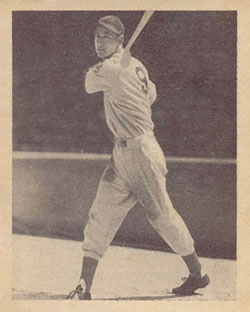
First Mainstream Card:  1939 Play Ball #92
Topps Flagship Set Appearances (10):  1954-58, 1969-72, 1976
Most Recent Mainstream Card:  2025 Topps Tribute #38
Total Non-Parallel Baseball Cards:  3,200 in the Beckett online database as of 8/6/25.

Update Cards
For my 1965 Topps blog, I used the team card posts to come up with five or six candidates per team for an imaginary update series.  With no team cards in the 1969 Topps set, I'll use each manager card for this exercise, and come up with a list of deserving cards to be included in an 8th/update series. 
  • Lee Maye (rf) - Lee Maye started more games in right field than any other Senators player, and he's in the set on an Indians Rookie Stars (#595) card.
  • Zoilo Versalles (inf) - Zoilo Versalles is also in the set with the Padres (#38), a team he'd never play for.  He appeared in 31 games for the Senators after playing in 72 games with the Indians.  I'd probably have him in my update set with the Indians, but maybe he gets a Senators card too if I need to fill out the checklist.
  • Darold Knowles (lhp) - Darold Knowles was 9-2 with a 2.24 ERA in 53 relief appearances.  Topps skipped him entirely in its 1969 set.
  • Jim Shellenback (lhp) - Jim Shellenback appeared in 30 games and made 11 starts.  He's in the set on a Pirates Rookie Stars (#567) card.
  • Toby Harrah (ss) - Toby Harrah was a September call-up by the Senators and he'd go on to be a four-time All-Star.  His rookie card is in the 1972 Topps set.
  • Wayne Terwilliger (coach) - If I bump the Versalles' Senators card from the set, I'd give a card to one of my Dad's all-time favorites.  How about that Wayne Ter-WILL-Iger?
Sources:  
Baseball Reference - Williams / Baseball Reference - 1969 Senators / SABR / Wikipedia

Tuesday, March 25, 2025

#577 Mike Hegan - Seattle Pilots


James Michael Hegan
Seattle Pilots
First Base-Outfield

Bats:  Left  Throws:  Left  Height:  6'1"  Weight:  188
Born:  July 21, 1942, Cleveland, OH
Signed:  Signed by the New York Yankees as an amateur free agent, August 9, 1961
Major League Teams:  New York Yankees 1964, 1966-67; Seattle Pilots 1969; Milwaukee Brewers 1970-71; Oakland Athletics 1971-73; New York Yankees 1973-74; Milwaukee Brewers 1974-77
World Series Appearances:  New York Yankees 1964; Oakland Athletics 1972
Died:  December 25, 2013, Hilton Head, SC (age 71)

Mike Hegan grew up around baseball as his father, Jim Hegan, was a long-time catcher and a five-time All-Star between 1941 and 1960.  The younger Hegan was drafted by the Yankees, and he'd appear in five regular season games in 1964 as a September call-up.  With an injury to Tony Kubek, Hegan was added to the World Series roster following the season, seeing action in three different postseason games.  He wouldn't get a shot at regular playing time until the Pilots picked him up in one of the franchise's first transactions.  Hegan was the opening day right fielder for the Pilots, and he was named the Pilots' only All-Star for that year's All-Star Game.  Don Mincher (#285) replaced Hegan on the roster as the outfielder was injured at the time.  The Pilots relocated to Milwaukee for the 1970 season, and Hegan was the opening day first baseman for the Brewers, ultimately appearing in a career-high 148 games.  Hegan's next role was as a pinch-hitter and defensive replacement for the Athletics' dynasty of the early 1970s.  He'd go to the postseason in 1971 and 1972 with the team and win a ring when the Athletics defeated the Reds in seven games in 1972.

1976 Topps #69
The next five years saw Hegan as a reliable bench player and designated hitter, doing repeat stints with the Yankees and then the Brewers.  In 966 games, Hegan batted .242 with 504 hits, 53 home runs and 229 RBIs.  He'd begin his second career in the Brewers' broadcast booth between 1978 and 1988, and joined the Indians broadcast team in 1989, retiring following the 2011 season.

Building the Set / Card #486
December 15, 2024 from The Philly Show (Uncle Dick's Cards)
On Sunday, December 15th, Doug and I attended the latest Philly Show, spaciously spread out inside Hall A of the Greater Philadelphia Expo Center in Oaks, Pennsylvania.  I wrote a full show report over at The Phillies Room, including some thoughts on attending the show with our oldest son, who first graced the Philly Show floors back in 2012.

Having had success the prior two shows at Uncle Dick's Cards with his well-organized, neon common binders, I opted to pull up a chair once again at the friendly dealer's array of tables.  The aim was simple:  Clear out Uncle Dick's 1969 Topps commons, starting off where I had left off the year before with card #501 and going through the end of the set, card #664.  In less than 25 minutes, I completed my quest, and this is the 42nd of 98 commons pulled from the binder.  After a generous dealer discount due to my bulk purchase, this card cost me a little less than $2.

The Card / Pilots Team Set / Accuracy Index -8
Hegan is wearing a Yankees jersey here, and it's odd Topps couldn't get a photo of him in his new uniform when the other Pilots players on the checklist this late are all sporting their new Pilots' gear.  The write-up on the back explains Hegan had joined the organization before the expansion draft.  Jim Hegan makes a cameo in the cartoon, and the elder Hegan was a coach with the Yankees (1960-73; 1979-80) during both of the younger Hegan's stints with the club.

Accuracy Index:  Hegan scores a rare, for a later series card, -8.

1969 Season
On June 14, 1968, the Pilots purchased Hegan's contract from the Yankees, making him one of the first players on the Pilots' roster.  He hit the first home run in Pilots' history, a two-run shot on opening day in the top of the first, off the Angels' Jim McGlothlin (#386).  Tommy Harper (#42) had doubled to lead off the game.  Hegan was batting .296 when he was selected to the American League All-Stars, but an injury derailed his trip to RFK Stadium in Washington.  Hegan appeared in 95 games overall, batting .292 with eight home runs and 37 RBIs.

1967 Topps #553
1970 Topps #111
1971 Topps #415
1973 Topps #382
1977 Topps #507

Other Notable Baseball Cards

First Mainstream Card:  1967 Topps #553
Topps Flagship Set Appearances (11):  1967-77
Most Recent Mainstream Card:  2002 Upper Deck Vintage Special Collection Game Jersey #S-MH
Total Non-Parallel Baseball Cards:  56 in the Beckett online database as of 3/16/25.

Sources:  
Baseball Reference / SABR / Wikipedia

Tuesday, January 21, 2025

#20 Ernie Banks - Chicago Cubs


Ernest Banks
Chicago Cubs
First Base

Bats:  Left  Throws:  Right  Height:  6'1"  Weight:  180
Born:  January 31, 1931, Dallas, TX
Signed:  Signed by the Chicago Cubs a free agent in 1953
Major League Teams:  Chicago Cubs 1953-71
Died:  January 23, 2015, Chicago, IL (age 83)
Hall of Fame Induction:  1977

Known by most simply as "Mr. Cub," Ernie Banks enjoyed a 19-year playing career and encapsulated everything that a baseball player should aspire to be.  His genuine appreciation and affection for the game was unrivaled.  Banks was the runner-up to Wally Moon in 1954 for the National League Rookie of the Year Award and he won the league's MVP honors in 1958 and 1959.  An 11-time All-Star, Banks hit 512 career home runs and tallied 1,636 career RBIs.  He excelled defensively at both shortstop (1953-61) and first base (1962-71).  When he hit his 500th career home run on May 12, 1970, he became just the ninth member to join that exclusive club.  Banks batted .274 in 2,528 games for the Cubs, with 2,583 hits, and his #14 was the first number retired by the franchise in 1982.

During his Hall of Fame induction speech in 1977, Banks repeated his famous quote, "There's sunshine, fresh air, and the team's behind us.  Let's play two."

Some text for this post originally appeared on my 1956 Topps blog.

Building the Set / 
Card #441
April 9, 2024 from Wenonah, NJ (Gar Miller Baseball Cards)
On April 7th, I received an e-mail from Gar Miller, hobby icon, informing me and other customers he had recently updated his inventory of vintage baseball cards for sale at garmillercards.com.  In need of some vintage cardboard, and wanting to see if Miller had any Diamond Stars cards I needed, I decided to check out the new inventory.  

A high-number Red Lucas card from the Diamond Stars set was reasonably priced, so I added it, a few cards needed for our 1969 Topps set and a few random Phillies-related cards to my cart and submitted my order.  Given the proximity of Miller to our house, I wasn't surprised when the cards arrived in our mail box in two days.  Banks joined Don Drysdale (#400) and the Graig Nettles (#99) rookie card as the trio of cards added to our 1969 Topps set.

The Card / Cubs Team Set / Accuracy Index +1
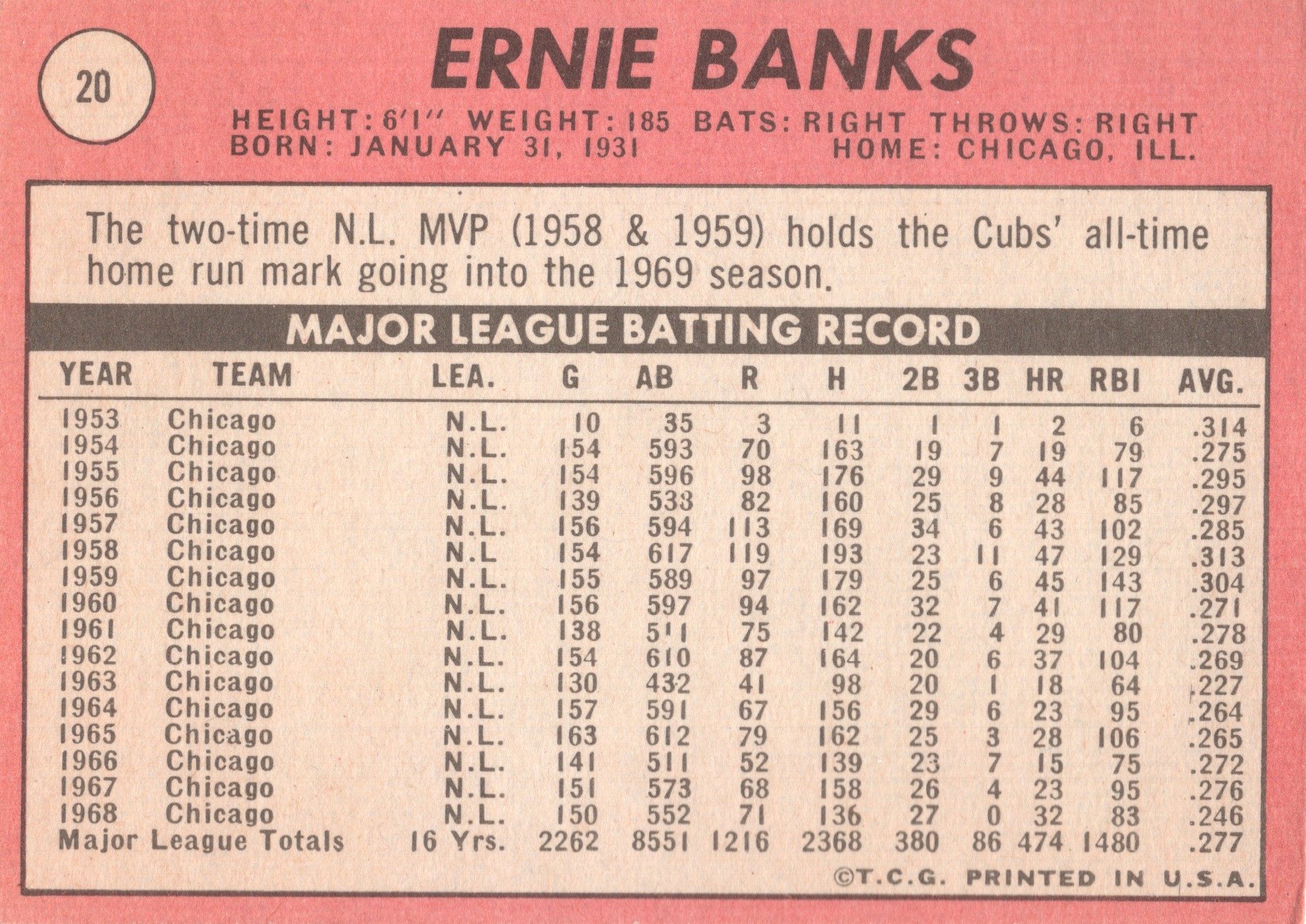
Topps used this exact same photo on Banks' 1968 base card.  The back of the card is mostly statistics, save for the two lines of text at the top.  Banks was the Cubs' all-time home run leader until 2004, when he was surpassed by Sammy Sosa.  Sosa hit 545 home runs with the Cubs, and 609 home runs overall.  Topps included a reprint of this card in its 2019 Topps Update Iconic Card Reprints insert set.

Accuracy Index:  Banks' card loses points for the repeat photo.

1969 Season
This was to be Banks' final year as an everyday player, and he batted .253 in 155 games for the Cubs.  The 38-year-old hit 23 home runs and drove in 106, the eighth and final season he cleared 100 RBIs.  This was also the closest Banks ever came to playing in the postseason.  His Cubs were in first place in the National League East as late as September 9th, a position they had held since opening day.  Over the final 20 games of the season, the Cubs went 8-12 to lose their grip on the division, with the Mets surprisingly winning the pennant.  This was also the year Banks was first credited, by sportswriter Jimmy Enright, of exclaiming, "Let's Play Two," before a game in July with the temperature exceeding 100 degrees.

1954 Topps #94
1956 Topps #15
1968 Topps #355
1971 Topps #525
1975 Topps #197

Other Notable Baseball Cards

First Mainstream Card:  1954 Topps #94
Topps Flagship Set Appearances (20):  1954-71, 1973, 1975
Most Recent Mainstream Card:  2024 Stadium Club #88
Total Non-Parallel Baseball Cards:  2,219 in the Beckett online database as of 12/27/24.

Sources:  
Baseball Reference / SABR / Wikipedia

Thursday, November 23, 2023

#124 Hank Bauer MG - Oakland Athletics


Henry Albert Bauer
Oakland Athletics

Manager

Bats:  Right  Throws:  Right  Height:  6'0"  Weight:  192
Born:  July 31, 1922, St. Louis, IL
Signed:  Signed by the New York Yankees as an amateur free agent before 1946 season
Major League Teams:  New York Yankees 1948-1959; Kansas City Athletics 1960-1961
World Series Appearances:  New York Yankees 1949-1953, 1955-1958; Baltimore Orioles 1966
As a Manager:  Kansas City Athletics 1961-1962; Baltimore Orioles 1964-1968; Oakland Athletics 1969
Died:  February 9, 2007, Lenexa, KS (age 84)

Hank Bauer was a hero during World War II before joining the Yankees and winning seven World Series rings with the club as their regular right fielder.  Bauer was consistently dependable throughout his Yankees tenure, and between 1950 and 1959 he batted .279 with an average of 15 home runs and 60 RBIs per season.  Bauer owned a 17-game World Series hitting streak, still a record today as tied by Derek Jeter, and contributed a three-run triple in the decisive Game 6 fo the 1951 World Series.  He slugged four home runs in the 1958 World Series, his final postseason action as a player.  Bauer was a three-time All-Star between 1952 and 1954, and earned MVP votes each year between 1952 and 1956.  He was dealt to the Athletics in December 1959 as part of the deal that brought Roger Maris (#164) to the Bronx.  While Maris went on to set the single-season home run record, Bauer played in parts of two seasons with the Athletics, becoming their player-manager in June 1961, before retiring as a player and focusing on his managing career.  Bauer retired with 1,424 hits, 164 home runs, 703 RBIs and a .277 career average.

His first managerial stint with the Athletics lasted only through the 1962 season.  He joined the Orioles as a first base coach in 1963, and was promoted to their manager following the season.  Bauer guided the Orioles to their first ever World Series title in 1966, sweeping the heavily favored Dodgers in four games.  His success with the Orioles waned after a few years and he was fired on July 10, 1968, to be replaced by Orioles' first base coach Earl Weaver (#516).  Bauer managed one last time, returning to the Athletics, now in Oakland, for the 1969 season.  His lifetime managerial record was 594-544-1.  Bauer managed the Mets' top farm team in Tidewater in 1971 and 1972, before leaving the dugout for good.  He was inducted into the Baltimore Orioles Hall of Fame in 1990.

Some text for this post originally appeared on my 1956 Topps blog.

Building the Set / 
Card #160
March 12, 2023 from The Philly Show (Uncle Dick's Cards)
In mid-March, Doug and I attended the Philadelphia Sports Collectors Show, held within the Greater Philadelphia Expo Center in Oaks, Pennsylvania.  My main focus for this show was accumulating as many 1969 Topps commons as possible, which I did by adding a grand total of 193 cards to our set.  That's almost 30% of the entire set added in one enjoyable afternoon.  I wrote a full summary of the show in a post over at The Phillies Room, found here.

This is the 83rd of the 193 commons and semi-stars purchased, pulled and stacked from the first two neon green binders housing 1969 Topps cards at the multi-table spread of Uncle Dick's Cards from Babylon, New York.  My method was simple - I pulled up a chair, found a card I needed, picked the best of the group from the binder page and set it aside.  After each 100 cards, I'd ask the dealer to tell me how much damage I had done so far.  With a budget in mind, I kept going twice, continuing after card #100 and card #200, and stopping at card #298.  The final amount due was 17% off the sticker price for the pile of 193 cards, with this card costing less than $2.

The Card / Athletics Team Set / Accuracy Index -8
This is Bauer's 18th and final appearance in a Topps flagship set.  The photo is likely from 1964, as it seems similar to the photo used for his 1965 Topps card, except Bauer is hatless here.  His impressive 17-game World Series hitting streak is highlighted on the back of the card.

Accuracy Index:  Bauer is hatless (-3) and wearing an Orioles uniform (-5).

1969 Season
In his only season as manager of the Athletics while the team was in Oakland, Bauer had the A's in first place at various times between mid-May and early July.  They would fall behind the surging Twins, ultimately finishing in second place, nine games behind the pennant winners in the new A.L. West division.  The summer swoon cost Bauer his job, and owner Charles Finley replaced him with John McNamara for the season's final 13 games.  The Athletics were building a nucleus of young stars around future Hall of Famers Reggie Jackson (#260), Catfish Hunter (#235) and Rollie Fingers (#597).  Bauer's hitting coach was former Yankee teammate Joe DiMaggio.

Jackson was the top player on the club, batting .275 while leading the team in home runs (47) and RBIs (118).  Third baseman Sal Bando (#371) had a great season at the plate too, batting .281 with 31 home runs and 113 RBIs.  Chuck Dobson (#397) and Blue Moon Odom (#195) were 15-game winners, while Fingers led the bullpen with 12 saves.  The Athletics would win three World Series titles in a row between 1972 and 1974.

1950 Bowman #219
1954 Topps #130
1959 Topps #240
1965 Topps #323
1967 Topps #1

Other Notable Baseball Cards

First Mainstream Card:  1950 Bowman #219
Topps Flagship Set Appearances (18):  1951-1952, 1954-1962, 1964-1969
Most Recent Mainstream Card:  2010 Topps New York Yankees 27 World Series Championships #YC13
Total Non-Parallel Baseball Cards:  298 in the Beckett online database as of 10/29/23.

Update Cards
For my 1965 Topps blog, I used the team card posts to come up with five or six candidates per team for an imaginary update series.  With no team cards in the 1969 Topps set, I'll use each manager card for this exercise, and come up with a list of deserving cards to be included in an 8th/update series.
  • Joe DiMaggio (coach) - This is a favorite target of custom card makers, as DiMaggio was the Athletics' hitting coach in 1968 and 1969.
  • Rollie Fingers (rhp) - Fingers shares a Rookie Stars card with two other American League pitchers, and I'd give him his own solo card here.
  • Jose Tartabull (of) - Tartabull appears in the set with the Red Sox (#287).  Sold to the Athletics in early May, he'd be a regular outfielder for the club over the summer.
  • Jim Roland (lhp) - Reliever Roland is in the set with the Twins (#336), but he was acquired by the Athletics during spring training.
  • Bobby Brooks (of) - Brooks shares Rookies Stars cards with other prospects in the 1970 and 1971 Topps set, and he's the only player on the club with at least 100 plate appearances who didn't appear in the 1969 Topps set.
  • Marcel Lachemann (rhp) - Lachemann's rookie card wouldn't come until the 1971 Topps set, but he relieved in 28 games for the Athletics in 1969.
  • Gene Tenace (c) - Tenace and pitcher Vida Blue share a Rookie Stars card in the 1970 Topps set.
If additional cards were needed to fill out the update set's checklist, I'd add a card for Tony LaRussa, who appeared in eight games for the Athletics.  Blue would also get an honorary mention card, as the young pitcher appeared in 12 games for the Athletics.

Sources:  
Baseball Reference - Bauer / Baseball Reference - 1969 Athletics / SABR / Wikipedia

Saturday, May 6, 2023

#18 Dick Schofield - St. Louis Cardinals


John Richard Schofield
St. Louis Cardinals
Infield

Bats:  Both  Throws:  Right  Height:  5'9"  Weight:  163
Born:  January 7, 1935, Springfield, IL
Signed:  Signed by the St. Louis Cardinals as an amateur free agent, June 3, 1953
Major League Teams:  St. Louis Cardinals 1953-1958; Pittsburgh Pirates 1958-1965; San Francisco Giants 1965-1966; New York Yankees 1966; Los Angeles Dodgers 1967; St. Louis Cardinals 1968; Boston Red Sox 1969-1970; St. Louis Cardinals 1971; Milwaukee Brewers 1971
World Series Appearances:  Pittsburgh Pirates 1960; St. Louis Cardinals 1968
Died:  July 11, 2022, Springfield, IL (age 87)

Infielder Dick Schofield spent much of his 19 years in the big leagues as a back-up, late-inning defensive replacement, pinch-hitter or pinch-runner and he started over 100 hundred games just three times, all between 1963 and 1965.  Nicknamed "Ducky," Schofield made his big league debut a few weeks out of high school as an 18-year-old bonus baby with the Cardinals.  He was dealt to the Pirates in June 1958, but the club didn't have much use for his services with Bill Mazeroski (#335) at second base and Dick Groat  at shortstop.  However Schofield played a pivotal role in the Pirates reaching the World Series in 1960, when he replaced Groat at short after the league's eventual MVP broke his wrist in the beginning of September.  Schofield batted .403 during the month as the Pirates would go on to reach the Series and defeat the Yankees in seven games.

After Groat's trade to the Cardinals following the 1962 season, Schofield finally got the chance to start and was the Pirates' regular shortstop for two seasons.  Dealt again to the Giants early in the 1965 season, Schofield saw regular playing time until a young Tito Fuentes was ready to take over at short.  Schofield played for six more seasons, bouncing around to six different teams before retiring as a player in 1972.  His son, also Dick Schofield, played for 14 seasons in the majors, primarily with the Angels.  His grandson, Jayson Werth, played for 15 seasons, winning a World Series ring with the Phillies in 2008.

Some text for this post originally appeared on my 1965 Topps blog.

Building the Set / 
Card #82
March 12, 2023 from The Philly Show (Uncle Dick's Cards)
In mid-March, Doug and I attended the Philadelphia Sports Collectors Show, held within the Greater Philadelphia Expo Center in Oaks, Pennsylvania.  My main focus for this show was accumulating as many 1969 Topps commons as possible, which I did by adding a grand total of 193 cards to our set.  That's almost 30% of the entire set added in one enjoyable afternoon.  I wrote a full summary of the show in a post over at The Phillies Room, found here.

This is the fifth of the 193 commons and semi-stars purchased, pulled and stacked from the first two neon green binders housing 1969 Topps cards at the multi-table spread of Uncle Dick's Cards from Babylon, New York.  My method was simple - I pulled up a chair, found a card I needed, picked the best of the group from the binder page and set it aside.  After each 100 cards, I'd ask the dealer to tell me how much damage I had done so far.  With a budget in mind, I kept going twice, continuing after card #100 and card #200, and stopping at card #298.  The final amount due was 17% off the sticker price for the pile of 193 cards, with this card costing me less than a dollar.  If I stick to composing posts five times a week, which may slip through the summer months, I should go through the stack and be caught up by the week of January 22, 2024!

The Card / Cardinals Team Set / Accuracy Index -10
Schofield is wearing a Pirates jersey here, a team he hadn't played with since the 1965 season.  It looks as if the photo is from the same session as the photo used for his 1965 Topps card.  The back of the card alerts readers Schofield had already move on to the Red Sox.  Granted, this card comes early in the set, but if Topps could update the text on the back to reflect the December 1968 trade, couldn't they have also easily updated the team designation on the front to the Red Sox?

Accuracy Index:  Schofield's card rates a -10 since he's wearing a Pirates jersey (-5) and hatless (-3), along with being shown on a team he didn't play for in 1969 (-2).

1969 Season
On December 3, 1968, the Cardinals traded Schofield to the Red Sox for pitcher Gary Waslewski (#438), ending his second of three stints with St. Louis.  (Waslewski appears in the set in a later series, showing him with the Cardinals.)  Schofield served a super utility role in Boston, playing all three infield positions and both corner outfield spots.  He appeared in 94 games, making 35 starts at second base, six starts at third and three starts at shortstop.  He batted .257 overall and .333 (11 for 33) as a frequently used pinch-hitter by manager Dick Williams (#349).

1954 Topps #191
1961 Topps #453
1966 Topps #474
1971 Topps #396
1985 Topps #138

Other Notable Baseball Cards

First Mainstream Card:  1954 Topps #191
Topps Flagship Set Appearances (17):  1954-1955, 1958-1971, 1985
Most Recent Mainstream Card:  1994 Topps Archives 1954 #191
Total Non-Parallel Baseball Cards:  58 in the Beckett online database as of 5/1/23.

Sources:  
Baseball Reference / SABR / Wikipedia

Tuesday, April 25, 2023

#565 Hoyt Wilhelm - California Angels


James Hoyt Wilhelm
California Angels

Pitcher

Bats:  Right  Throws:  Right  Height:  6'0"  Weight:  190
Born:  July 26, 1922, Huntersville, NC
Acquired:  Purchased by the Boston Braves from Mooresville (North Carolina State), October 28, 1947
Major League Teams:  New York Giants 1952-1956; St. Louis Cardinals 1957; Cleveland Indians 1957-1958; Baltimore Orioles 1958-1962; Chicago White Sox 1963-1968; California Angels 1969; Atlanta Braves 1969-1970; Chicago Cubs 1970; Atlanta Braves 1971; Los Angeles Dodgers 1971-1972
World Series Appearances:  New York Giants 1954
Died:  August 23, 2002, Sarasota, FL (age 80)
Hall of Fame Induction:  1985

Hoyt Wilhelm served during World War II, seeing action at the Battle of the Bulge, before making his big league debut with the Giants in 1952 at the age of 29.  On the strength of his resiliency and his knuckle ball, he went on to have a Hall of Fame career over the next 21 seasons, pitching until he was nearly 50 years old.  His sole postseason action came in 1954 when his Giants swept the Indians in four games in the World Series.  Wilhelm was an eight-time All-Star and his league's ERA leader in 1952 with the Giants and 1959 with the Orioles.  He threw a no-hitter with the Orioles in 1958 and 1959 was perhaps his best season as he appeared in 32 games and went 15-11 with a 2.19 ERA and a career-high 139 strikeouts.  He appeared with nine different teams, spending the most time with the White Sox.  Between 1963 and 1968 with the White Sox, Wilhelm went 41-33 with a 1.92 ERA and 99 saves.  He was the oldest player in the majors between 1966 and his retirement in 1972.

1988 Pacific Legends I #76
Wilhelm holds the major league record for wins in relief (124) and he was also the first pitcher in major league history to reach the 200 save plateau and to appear in 1,000 games.  For his career, Wilhelm was 143-122 in 1,070 games pitched (currently 6th all-time) with 228 saves (43rd) and 1,610 strikeouts.  Upon his retirement, he had the lowest career ERA (2.52) of any pitcher since 1927 (Walter Johnson) with at least 2,000 innings pitched.  He briefly managed in the minor leagues following his retirement, and then was a minor league pitching coach with the Yankees for 22 years.  Wilhelm was inducted into the Baseball Hall of Fame in 1985 and the Baltimore Orioles Hall of Fame in 2002.

Some text for this post originally appeared on my 1965 Topps blog.

Building the Set / Card #74
February 13, 2023 from Wenonah, NJ (Gar Miller Cards)
Given my chosen profession, I sit through an inordinate amount of work meetings, which are now almost all virtual in this post-pandemic world.  On some occasions, these meetings are admittedly a combination of boring, unneeded, too lengthy or some combination of all three.  During a recent early February virtual work meeting, and after it became apparent the meeting had derailed into matters unimportant to me personally, I bought a bunch of old baseball cards.  Gar Miller is a noted hobby luminary, and he still sells vintage baseball cards via his online store, Gar Miller Cards.  I navigated over to his website, picking up a small stack of cards from this 1969 Topps set build and a few bonus cards for our not yet officially collecting 1955 Bowman and 1959 Topps sets.  For those watching me on screen during the virtual work meeting, I had the appearance of someone smiling, nodding appreciatively and following along attentively.  But in reality, I was adding baseball cards to my online cart, including this Wilhelm card which was $12.

The Card / Angels Team Set / Accuracy Index -8
Wilhelm is wearing a White Sox jersey here, and the photo appears to come from the same session as the photo used for his 1965 Topps card.  The back of the card is nothing but glorious statistics for the future Hall of Famer.

Accuracy Index:  Wilhelm receives a -8 for the White Sox jersey (-5) and the logo-less hat (-3).
Inserts:  Wilhelm is included in the 35 card Topps Deckle Edge insert set and is one of 48 decals in the Topps Decals insert set.  He's one of 27 players and one of only eight future Hall of Famers to appear in both insert sets.  Given the composition of the Deckle Edge checklist, and while Wilhelm's hat is logo less,  his card here was meant to be a Royals card.  When he was traded to the Angels, Topps pulled the Wilhelm card and replaced him with Joe Foy so that the Royals could be represented by someone actually on their team.  (See below and my Deckle Edge Insert Set page for more detail.)


1969 Season
Wilhelm, at 46 years old, was left unprotected by the White Sox in the expansion draft and selected by the Royals as the 49th pick on October 15, 1968.  He'd never wear a Royals uniform, as the team traded him to the Angels on December 12, 1968 for Ed Kirkpatrick (#529) and Dennis Paepke.  Wilhelm, along with closer Ken Tatum, was one of the Angels' better relievers, going 5-7 with a 2.47 ERA in 44 games.  He pitched 65 2/3 innings, saving 10 games.  On September 8th, Wilhelm was traded to the Braves with Bob Priddy (#248) for Clint Compton and Mickey Rivers.  The Braves were attempting to win the National League West pennant, and Wilhelm may have been the player to put them over the top.  In eight games with the Braves, Wilhelm was 2-0 with a 0.73 ERA, striking out 14 in 12 1/3 innings.  He converted four saves as the Braves would win the pennant.  Acquired too late for postseason eligibility, Wilhelm had to watch from the dugout as the Braves were swept in three games in the NLDS by the Mets.

1952 Topps #392
1954 Topps #36
1959 Topps #349
1965 Topps #276
1972 Topps #777

Other Notable Baseball Cards

First Mainstream Card:  1952 Topps #392
Topps Flagship Set Appearances (20):  1952-1954, 1956-1972
Most Recent Mainstream Card:  2022 Topps Now Turn Back the Clock #116
Total Non-Parallel Baseball Cards:  493 in the Beckett online database as of 2/21/23.

Sources:  
Baseball Reference / SABR / Wikipedia