Showing posts with label Philadelphia Phillies. Show all posts

Tuesday, September 9, 2025

#297 Deron Johnson - Philadelphia Phillies


Deron Roger Johnson
Philadelphia Phillies
Third Base-First Base

Bats:  Right  Throws:  Right  Height:  6'2"  Weight:  200
Born:  July 17, 1938, San Diego, CA
Signed:  Signed by the New York Yankees as an amateur free agent before 1956 season
Major League Teams:  New York Yankees 1960-61; Kansas City Athletics 1961-62; Cincinnati Reds 1964-67; Atlanta Braves 1968; Philadelphia Phillies 1969-73; Oakland Athletics 1973-74; Milwaukee Brewers 1974; Boston Red Sox 1974; Chicago White Sox 1975; Boston Red Sox 1975-76
World Series Appearances:  Oakland Athletics 1973
Died:  April 23, 1992, Poway, CA (Age 53)

Slugger Deron Johnson accumulated 245 home runs over a 16-year career that benefited from the advent of the American League designated hitter in 1973.  Johnson enjoyed a career year in 1965, leading the National League in RBIs with 130 and slugging 32 home runs while hitting .287.  He finished fourth that season in MVP voting behind the eventual winner Willie Mays (#190), Sandy Koufax and Maury Wills (#45).  He hit over 20 home runs in a season six times and cleared the 80 RBI mark seven times.

From the 1969 Phillies Yearbook
His sole postseason appearance came in 1973 with the World Champion Athletics.  Johnson appeared in six of the seven games, hitting .300 (3 for 10).  Following his playing days, Johnson served as a coach for the Angels (1979-80, 1989-91), Mets (1981), Phillies (1982-84), Mariners (1985-86) and White Sox (1987).  When he passed away from lung cancer in 1992, the Angels honored their former coach by wearing his initials, "DJ," on the sleeve of their jerseys for the remainder of the season.

Some text for this post originally appeared on my 1965 Topps blog.

Building the Set / Card #556
December 15, 2024 from The Philly Show (Vintage Cardboard Collectibles)
On Sunday, December 15th, Doug and I attended the latest Philly Show, spaciously spread out inside Hall A of the Greater Philadelphia Expo Center in Oaks, Pennsylvania.  I wrote a full show report over at The Phillies Room, including some thoughts on attending the show with our oldest son, who first graced the Philly Show floors back in 2012.

Having spent the first half hour or so pulling 98 commons and semi-stars from the neon green binder of Uncle Dick's Cards, and adding the big purchase of the day, the Rollie Fingers (#597) rookie card, and after adding a few more star cards, the remaining cash I had was starting to burn a hole in my wallet.  I had noticed the common/semi-star boxes at the tables of Vintage Cardboard Collectibles, and I found 14 more cards for our 1969 Topps set and six cards for our not-yet-officially collecting 1959 Topps set.  This is the 11th of those 14 cards.  After the obligatory dealer discount, I handed over the last of my cash, and we exited the show for the drive home.

The Card / Phillies Team Set / Accuracy Index -8
I'd guess Johnson is wearing a Reds' road uniform here, as the Braves uniforms (his team in 1968) had a stripe around the collars.  His solid 1965 season is highlighted in the write-up on the back of the card.

Accuracy Index:  It's yet another -8 for Johnson's card due to the former team uniform (-5) and lack of a hat (-3).

1969 Season
Johnson was the opening day third baseman for the Phillies, but ended up playing more games in left field than any of his other teammates.  He started 131 games overall - 70 in left field, 47 at third base and 14 at first base.  In 138 games, Johnson batted .255 with 17 home runs and 80 RBIs.  The latter mark second on the team behind Dick Allen (#350), who drove in 89.

Phillies Career
Johnson was purchased from the Braves by the Phillies on December 3, 1968.  He had a good run with the Phillies, serving as their regular left fielder in 1969, and then moving back to first base for the next three seasons.  In 563 games with the Phillies, the longest tenure with any team during his career, Johnson hit .251 with 88 home runs and 304 RBIs.  He hit 22 home runs at home in 1971, breaking Del Ennis' home record set in 1950.  On July 10th and 11th, Johnson hit four consecutive home runs against the Expos, which he listed as one of his career highlights along with playing in the World Series.

Having lost the starting first baseman's job in 1973 to Willie Montanez, Johnson was traded to the A's on May 2nd for Jack Bastable.  He'd return to the Phillies in 1982 and he served as the team's hitting and first base coach during the Pat Corrales (#382) and Paul Owens era between 1982 and 1984.

1959 Topps #131
1962 Topps #82
1971 Topps #490
1974 Topps #312
1976 Topps #529

Other Notable Baseball Cards

First Mainstream Card:  1959 Topps #131
Topps Flagship Set Appearances (16):  1959-62, 1964-74, 1976
Most Recent Mainstream Card:  1990 Swell Baseball Greats #34
Total Non-Parallel Baseball Cards:  91 in the Beckett online database as of 8/17/25.

Sources:  
Baseball Reference / SABR / Wikipedia

Tuesday, May 20, 2025

#599 John Boozer - Philadelphia Phillies


John Morgan Boozer
Philadelphia Phillies
Pitcher

Bats:  Right  Throws:  Right  Height:  6'3"  Weight:  205
Born:  July 6, 1938, Columbia, SC
Signed:  Signed as an amateur free agent by the Philadelphia Phillies, July 9, 1958
Major League Teams:  Philadelphia Phillies 1962-64, 1966-69
Died:  January 24, 1986, Lexington, SC (age 47)

John Boozer spent his entire professional career within the Phillies' organization, pitching in 12 seasons overall with the club, including parts of seven seasons in the majors.  His best season came in 1961 with the Double-A Chattanooga Lookouts, when he went 19-9 with a 2.61 ERA, and four shutouts over 35 games.  Primarily used as a middle reliever, Boozer pitched in at least 20 games for the Phillies in five different seasons, reaching a career high 46 appearances during his final year playing in 1969.  Boozer was ejected from a game on May 2, 1968, when he was accused by home plate umpire Ed Vargo of throwing a spit ball with manager Gene Mauch (#606) also getting tossed.  In 171 games with the Phillies, Boozer was 14-16 with a 4.09 ERA and 15 saves.

Some text for this post originally appeared on my 1965 Topps blog.

Building the Set / 
Card #504
December 15, 2024 from The Philly Show (Uncle Dick's Cards)
On Sunday, December 15th, Doug and I attended the latest Philly Show, spaciously spread out inside Hall A of the Greater Philadelphia Expo Center in Oaks, Pennsylvania.  I wrote a full show report over at The Phillies Room, including some thoughts on attending the show with our oldest son, who first graced the Philly Show floors back in 2012.

Having had success the prior two shows at Uncle Dick's Cards with his well-organized, neon common binders, I opted to pull up a chair once again at the friendly dealer's array of tables.  The aim was simple:  Clear out Uncle Dick's 1969 Topps commons, starting off where I had left off the year before with card #501 and going through the end of the set, card #664.  In less than 25 minutes, I completed my quest, and this is the 60th of 98 commons pulled from the binder.  After a generous dealer discount due to my bulk purchase, this card cost me less than $1.50.

The Card / Phillies Team Set / Accuracy Index +5
This is Boozer's sixth and final appearance in a Topps flagship set.  The cartoon on the back shows Boozer's offseason hobby - fishing.

Accuracy Index:  It's a solid +5 for Boozer's card.

1969 Season
Boozer went to spring training with the Phillies as a non-roster invitee, spending April and May pitching for the Eugene Emeralds, his fourth Triple-A team within the Phillies organization.  He earned a promotion at the start of June, eventually pitching in 46 games and going 1-2 with a 4.28 ERA and six saves.  That tied him for the team lead in saves with Bill Wilson (#576).  Following the season, Boozer announced his retirement at the age of 30.

Phillies Career
Boozer's Baseball Reference page lists five different uniform numbers for the pitcher, which I find fascinating.  Either he was constantly requesting the change, or he was considered a marginal player who had his existing number taken away on numerous occasions by new, more experienced teammates.  There's also the fact Boozer was frequently shuttled between Triple-A and the Phillies, so that probably contributed to the frequent number changes too.  He started out with #29, then switched to #19 in 1964.  Rookie Pat Corrales (#382) made his debut in August 1964, getting assigned #29.  Boozer wore #19 until switching to #28 for the 1967 season.  Veteran Tito Francona (#398) arrived in 1967 and took #19.  Finally, in 1969, Boozer started with #28, switched to #21 and ended his Phillies career with #42.  Pitcher (and rookie) Luis Peraza wore #28 briefly at the start of the season, so I'm assuming it was Boozer's choice to switch to #21.  But then no one else assumed #21, and Boozer apparently decided on his own to switch again to #42?

1963 Topps #29
1964 Topps #16
1965 Topps #184
1966 Topps #324
1968 Topps #173

Other Notable Baseball Cards

First Mainstream Card:  1963 Topps #29
Topps Flagship Set Appearances (6):  1963-66, 1968-69
Most Recent Mainstream Card:  1969 Topps #599
Total Non-Parallel Baseball Cards:  21 in the Beckett online database as of 5/13/25.

Sources:  
Baseball Reference / SABR / Wikipedia

Monday, December 23, 2024

#477 Jeff James - Philadelphia Phillies


Jeffrey Lynn James
Philadelphia Phillies
Pitcher

Bats:  Right  Throws:  Right  Height:  6'3"  Weight:  195
Born:  September 29, 1941, Indianapolis, IN
Signed:  Signed by the Philadelphia Phillies as an amateur free agent, September 10, 1960
Major League Teams:  Philadelphia Phillies 1968-69
Died:  May 7, 2006, Indianapolis, IN (age 64)

Jeff James was signed the Phillies in 1960, worked his way slowly but steadily through their minor league system, and earned a spot on their pitching staff to start the 1968 season.  James appeared in 29 games, making 13 starts and was 4-4 with a 4.28 ERA in 115 2/3 innings pitched.  He threw a shutout against the Cubs on July 17th that season.  James started the 1969 season back in the minors, and he'd get a September call-up on the strength of his year with the Eugene Emeralds.  James appeared in his final six major league games that September.  He continued to pitch through the 1971 season in the Phillies and Padres organizations, before retiring from baseball.  In his short time with the Phillies, James was 6-6 with a 4.52 ERA in 35 games, including 18 starts.

1970 Topps #302
Building the Set / 
Card #420
December 3, 2023 from The Philly Show (Uncle Dick's Cards)
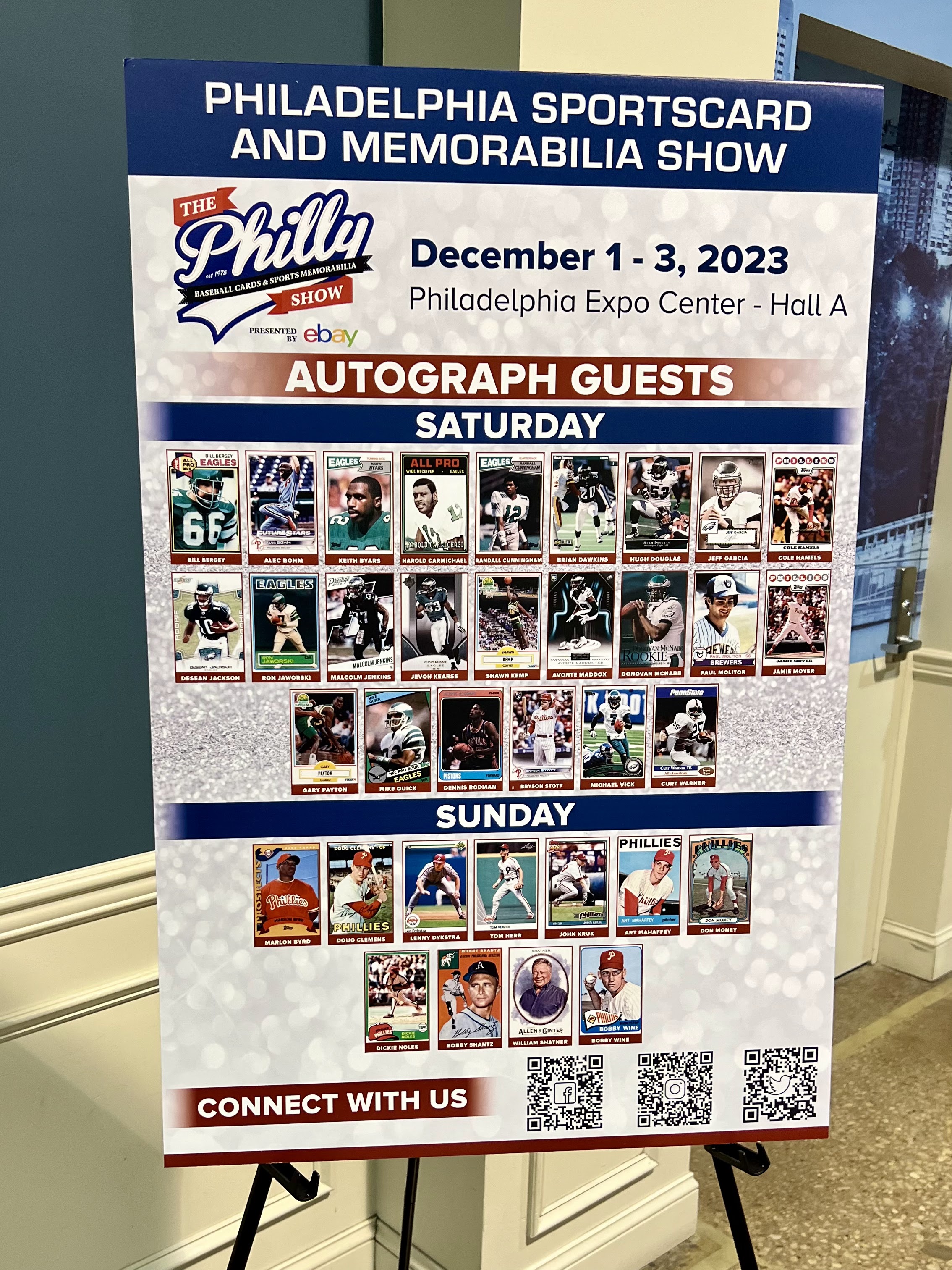
Doug and I returned to The Philly Show in early December, once again held inside the Greater Philadelphia Expo Center in Oaks, Pennsylvania.  eBay has taken over sponsorship of the show, with the quaint, bubble-lettered Philly Show logo that had been in place since the 1980s replaced with a more modern logo, keeping with the times.  I wrote about the show in a post over at The Phillies Room.

Similar to my strategy from March, I wanted to focus on accumulating commons and having found success with Uncle Dick's Cards before, I didn't mess around and headed right for the neon green binders.  I pulled 145 cards from the binder containing cards 301 to the end of the set, stopping when I reached 500.  This card was the 128th of 145 cards purchased for our set, and after the dealer discount due to my bulk purchase, it cost a little less than a dollar.

The Card / Phillies Team Set / Accuracy Index +5
I think James is posing at Wrigley Field in this photo?  If so, the photo could have been taken before one of his three appearances in Chicago during the 1968 season.  This is his rookie card, and Topps would give him his final card in its 1970 set.  The write-up on the back points to his success in 1967 as a member of the San Diego Padres, then the Phillies' top farm team.  He was 13-5 with a 3.23 ERA in 1967 for the Padres.

Accuracy Index:  James' card earns a +5.

Phillies Career / 1969 Season
There's not much more to add than what I've already summarized above.  James was 2-2 with a 5.40 ERA for the Phillies in 1969, making five starts.  His last great outing came on September 15th against the Pirates, when he threw a complete game victory, allowing three runs on nine hits, while striking out six.

Other Notable Baseball Cards

First Mainstream Card:  1969 Topps #477
Topps Flagship Set Appearances (2):  1969-70
Most Recent Mainstream Card:  1970 Topps #302
Total Non-Parallel Baseball Cards:  5 in the Beckett online database as of 11/27/24.

Sources:  
Baseball Reference / Wikipedia

Saturday, September 7, 2024

#369 Bob Skinner MG - Philadelphia Phillies


Robert Ralph Skinner
Philadelphia Phillies
Manager

Bats:  Left  Throws:  Right  Height:  6'4"  Weight:  190
Born:  October 3, 1931, La Jolla, CA
Signed:  Signed by the Pittsburgh Pirates as an amateur free agent before 1951 season
Major League Teams:  Pittsburgh Pirates 1954, 1956-63; Cincinnati Reds 1963-64; St. Louis Cardinals 1964-66
World Series Appearances:  Pittsburgh Pirates 1960; St. Louis Cardinals 1964
As a Manager:  Philadelphia Phillies 1968-69; San Diego Padres 1977

Bob Skinner spent over 50 years in baseball as a player, manager, coach and scout.  Most of his playing career was spent with the Pirates where he was an All-Star in 1958 and for both games in 1960.  As the regular left fielder for the Pirates, Skinner had his best season in 1958 when he batted .321 with 13 home runs and 70 RBIs, finishing in the top ten in the National League in most major offensive categories and earning MVP votes.  In 1960, Skinner was second on the club with 86 RBIs, behind only Roberto Clemente (#50) for the team lead, helping the Pirates clinch the pennant and eventually win the World Series in seven games over the Yankees.  After a few seasons with the Reds, Skinner ended his playing career as a pinch-hitter and back-up outfielder for the Cardinals.  He had four pinch-hitting appearances in the 1964 World Series, going 2 for 3 as St. Louis prevailed over the Yankees.  In 1,381 career games, Skinner batted .277 with 103 home runs and 531 RBIs.

Skinner began his managerial career in 1967 with the San Diego Padres, then the top minor league affiliate for the Phillies.  He won Minor League Manager of the Year honors after leading the Padres to an 85-63 record and winning the 1967 Pacific Coast League Championship.  On June 16, 1968, Skinner was named as the new manager of the Phillies after Gene Mauch (#606) was fired.  Skinner's time as manager of the Phillies would last a little over a year before he'd resign from the position.  

Skinner would coach in the majors with the Padres (1970-73, 1977), Pirates (1974-76, 1979-85), Angels (1978) and Braves (1986-88), and he earned his third World Series ring as the hitting coach for the Pirates in 1979.  He'd work in the Astros organization as a special assignment scout until 2009.  Skinner's son Joel played nine seasons in the majors with the White Sox, Yankees and Indians.  Joel Skinner briefly managed the Indians in the second half of the 2002 season.

Some text for this post originally appeared on my 1965 Topps blog.

Building the Set / Card #344
December 3, 2023 from The Philly Show (Uncle Dick's Cards)
Doug and I returned to The Philly Show in early December, once again held inside the Greater Philadelphia Expo Center in Oaks, Pennsylvania.  eBay has taken over sponsorship of the show, with the quaint, bubble-lettered Philly Show logo that had been in place since the 1980s replaced with a more modern logo, keeping with the times.  I wrote about the show in a post over at The Phillies Room.

Similar to my strategy from March, I wanted to focus on accumulating commons and having found success with Uncle Dick's Cards before, I didn't mess around and headed right for the neon green binders.  I pulled 145 cards from the binder containing cards 301 to the end of the set, stopping when I reached 500.  This card was the 52nd of 145 cards purchased for our set, and after the dealer discount due to my bulk purchase, it cost me less than $1.

The Card / Phillies Team Set / Accuracy Index -8
Skinner is wearing a Cardinals uniform here, in a photo taken during the latter end of his playing days.  On the back of the card, Topps could have highlighted his Minor League Manager of the Year honors from 1967, but they opted to point out his .321 average was fifth best in the league in 1958.  (Richie Ashburn won the batting title in 1958 with a .350 mark.)

Accuracy Index:  Skinner's card scores a -8 for the Cardinals uniform (-5) and lack of a hat (-3).

1969 Season
With ongoing distractions all season (see below), the Phillies lost 99 games on their way to a fifth place finish behind Skinner and his replacement, third base coach George Myatt.  Despite missing almost a month of the season, Dick Allen (#350) was still the team's top offensive force, batting .288 with 32 home runs and 89 RBIs.  Allen's .573 slugging percentage was third best in the league.  Center fielder Larry Hisle (#206) was second on the club with 20 home runs and left fielder Deron Johnson (#297) drove in 80 runs.  Grant Jackson (#174), Woodie Fryman (#51) and Rick Wise (#188) bolstered the pitching staff, winning 14, 12 and 15 games respectively.  Jackson and Wise both threw four shutouts.  The Phillies didn't have a lock at the back end of their bullpen, with eight different pitchers saving at least one game.

Phillies Career
Skinner's managerial career with the Phillies did not go well, which was somewhat surprising at the time given his success with the Triple-A Padres.  In 1968, Skinner inherited a team from Mauch in fifth place, but only 5 1/2 games out of first place.  The 1968 Phillies finished the season with 86 losses overall and 21 games out of first place.  In 1969, Skinner continued to clash with his star first baseman, Allen.  When Allen skipped a double header in New York on June 24th, he was suspended and missed the next 26 games.  With the Phillies front office seemingly negotiating with Allen behind Skinner's back, the manager abruptly resigned in early August.  The story from the Phillies was that Skinner resigned because the team wouldn't extend his contract beyond the 1969 season, but Skinner maintained the reason for his departure was the constant clashing with Allen.  Myatt managed the team for the remainder of the season.  Skinner was 92-123 overall for the Phillies, in a managerial tenure that lasted a little over one year.

1955 Topps #88
1958 Topps #94
1961 Topps #204
1965 Topps #591
1985 Topps #139

Other Notable Baseball Cards

First Mainstream Card:  1955 Topps #88
Topps Flagship Set Appearances (16):  1955-66, 1969, 1973-74, 1985
Most Recent Mainstream Card:  1992 Fleer ProCards #503
Total Non-Parallel Baseball Cards:  98 in the Beckett online database as of 8/10/24.

Update Cards
For my 1965 Topps blog, I used the team card posts to come up with five or six candidates per team for an imaginary update series.  With no team cards in the 1969 Topps set, I'll use each manager card for this exercise, and come up with a list of deserving cards to be included in an 8th/update series.

Surprisingly, the Phillies made very few moves in 1969, and all five player cards listed below aren't "traded" cards but cards that should have existed.
  • George Myatt (manager) - Myatt went 19-35 as the interim manager to finish out the season.  His only appearance in a Topps set came as a floating head on the Braves Coaches card in the 1960 Topps set.
  • Bill Champion (rhp) - Bill Champion made 20 starts and was 5-10 with a 5.01 ERA for the Phillies.
  • Lowell Palmer (rhp) - Reliever Lowell Palmer pitched 90 innings in 26 games.  Champion and Palmer would have rookie cards in the 1970 Topps set.
  • Al Raffo (rhp) - Al Raffo never appeared on a baseball card, and I'd right that wrong.  In 45 games, and 72 1/3 innings pitched in 1969, Raffo was 1-3 with a 4.11 ERA.
  • Don Money (shortstop) - I'd give regular shortstop Don Money his own card, as he shared a Rookie Stars card with Larry Colton (#454) in the set.
  • Larry Hisle (outfield) - Same goes for regular center fielder Larry Hisle, who shared a card with Barry Lersch (#206) in the set.
Sources:  
Baseball Reference - Skinner / Baseball Reference - 1969 Phillies / SABR / Wikipedia

Thursday, June 27, 2024

#329 Rick Joseph - Philadelphia Phillies


Ricardo Emelindo Joseph
Philadelphia Phillies
Third Base

Bats:  Right  Throws:  Right  Height:  6'1"  Weight:  192
Born:  August 24, 1939, San Pedro de Macoris, Dominican Republic
Signed:  Signed by the San Francisco Giants as an amateur free agent before 1959 season
Major League Teams:  Kansas City Athletics 1964; Philadelphia Phillies 1967-1970
Died:  September 8, 1979, Santo Domingo, Dominican Republic (age 40)

Originally drafted by the Giants in 1959, Rick Joseph was selected by the Athletics in the December 1963 minor league draft and saw his first big league action with Kansas City in 1964.  After two more years in the minor leagues, Joseph was selected again in the minor league draft, this time by the Phillies.  He'd have his best year in baseball in 1967, batting .300 with 24 home runs and 96 RBIs for the Triple-A San Diego Padres, winning the Pacific Coast League MVP award.  His minor league tear earned him a September call-up by the Phillies, and Joseph collected his first big league home run in the form of a walk-off, pinch-hit grand slam against the Dodgers on September 16, 1967.

He'd spend all of 1968, 1969 and 1970 as a bench player for the Phillies, his playing time peeking in 1969 with 64 starts at mostly third base.  The Phillies dealt him to the White Sox in January 1971 and Joseph would spend three more years in the minor and Mexican leagues before retiring.  In 270 major league games, Joseph batted .243 with 26 doubles, 13 home runs and 65 RBIs.

Building the Set / 
Card #315
December 3, 2023 from The Philly Show (Uncle Dick's Cards)
Doug and I returned to The Philly Show in early December, once again held inside the Greater Philadelphia Expo Center in Oaks, Pennsylvania.  eBay has taken over sponsorship of the show, with the quaint, bubble-lettered Philly Show logo that had been in place since the 1980s replaced with a more modern logo, keeping with the times.  I wrote about the show in a post over at The Phillies Room.

Similar to my strategy from March, I wanted to focus on accumulating commons and having found success with Uncle Dick's Cards before, I didn't mess around and headed right for the neon green binders.  I pulled 145 cards from the binder containing cards 301 to the end of the set, stopping when I reached 500.  This card was the 23rd of 145 cards purchased for our set, and after the dealer discount due to my bulk purchase, it cost me less than $1.

The Card / Phillies Team Set / Accuracy Index -12
There's a lot wrong with this card.  Joseph played in 17 games for the Athletics in 1964, which means this photo is likely five years old and it's also the same exact photo used for Joseph's 1968 Topps card.  The back of the card highlights his career year in 1967.  Joseph would finally get to appear in a Phillies uniform on his 1970 Topps card.

Accuracy Index:  Joseph's card loses points for the repeat photo (-4), the green and yellow Athletics jersey (-5) and the lack of a hat (-3).

Phillies Career / 1969 Season
The Phillies selected Joseph in the minor league draft on November 29, 1966 from the Athletics.  As mentioned above, his successful campaign with the Padres in 1967 earned him a September call-up, and Joseph would remain on the Phillies' roster through the 1970 season.  He played in 66 games for Gene Mauch's (#606) club in 1968, batting .219 and occasionally starting at first base in place of Bill White (#588) or at third base to give Tony Taylor (#108) a day off.  Joseph got more playing time in 1969 as his former Padres' manager, Bob Skinner (#369), took over the club and wrote Joseph's name in the line-up more often.  Joseph made 64 starts, including 50 starts at third base, at one point compiling a 16-game hitting streak.  It was the longest hitting streak for a Phillies player all season.  In 99 games overall, he batted .273 with 15 doubles, six home runs and 37 RBIs, by far his best season in the majors.

With Skinner gone in 1970, Joseph's playing time decreased again, and he'd make just 20 starts all season.  In 71 games overall, serving mostly as a pinch-hitter, Joseph batted .227.  On January 12, 1971, with young outfielder Greg Luzinski waiting in the wings, Joseph was dealt to the White Sox for reliever Darrell Brandon (#301).  In 253 games with the Phillies, Joseph batted .245 with 24 doubles, 13 home runs and 64 RBIs, accounting for most of his career numbers.

1968 Topps #434
1970 Topps #186

Other Notable Baseball Cards

First Mainstream Card:  1968 Topps #434
Topps Flagship Set Appearances (3):  1968-1970
Most Recent Mainstream Card:  1970 Topps #186
Total Non-Parallel Baseball Cards:  9 in the Beckett online database as of 6/9/24.

Sources:  
Baseball Reference / SABR / Wikipedia

Saturday, April 6, 2024

#276 Gary Wagner - Philadelphia Phillies


Gary Edward Wagner
Philadelphia Phillies
Pitcher

Bats:  Right  Throws:  Right  Height:  6'4"  Weight:  185
Born:  June 28, 1940, Bridgeport, IL
Signed:  Signed by the Philadelphia Phillies as an amateur free agent, September 6, 1961
Major League Teams:  Philadelphia Phillies 1965-1969; Boston Red Sox 1969-1970

Gary Wagner pitched in parts of six seasons in the majors and his first big league season in 1965 was also his best.  He relieved in 59 games for the Phillies that year, a career-high, and was 7-7 with a 3.00 ERA and a team-leading seven saves.  Despite being one of the more successful relievers for the Phillies his rookie season, he spent almost all of 1966 and 1967 in the minors, before coming up again for a full season in 1968.  He made 44 relief appearances for Gene Mauch's (#606) club, and his eight saves were second on the team behind Turk Farrell's (#531) 12.  Wagner found himself back in the minors following a rough start to his 1969 season, and the Phillies dealt him to the Red Sox that September.  He'd pitch in 38 games for the Red Sox in 1970, his final year in the majors.

From the 1969 Phillies Yearbook
Wagner attempted comebacks with the Triple-A Expos and Red Sox affiliates in 1971, retiring after only 10 games.  For his career, he was 15-19 in 162 games pitched, with a 3.70 ERA and 22 saves.

Building the Set / Card #256
March 12, 2023 from The Philly Show (Uncle Dick's Cards)
In mid-March last year, over a year ago at this point, Doug and I attended the Philadelphia Sports Collectors Show, held within the Greater Philadelphia Expo Center in Oaks, Pennsylvania.  My main focus for this show was accumulating as many 1969 Topps commons as possible, which I did by adding a grand total of 193 cards to our set.  That's almost 30% of the entire set added in one enjoyable afternoon.  I wrote a full summary of the show in a post over at The Phillies Room, found here.

This is the 179th of the 193 commons and semi-stars purchased, pulled and stacked from the first two neon green binders housing 1969 Topps cards at the multi-table spread of Uncle Dick's Cards from Babylon, New York.  My method was simple - I pulled up a chair, found a card I needed, picked the best of the group from the binder page and set it aside.  After each 100 cards, I'd ask the dealer to tell me how much damage I had done so far.  With a budget in mind, I kept going twice, continuing after card #100 and card #200, and stopping at card #298.  The final amount due was 17% off the sticker price for the pile of 193 cards, with this card costing me $1.25.

The Card / Phillies Team Set / Accuracy Index +1
Topps used the same exact photo previously featured on Wagner's 1967 Topps card.  The back of the card references his shoulder woes (see below) and also features a seal to highlight his college degree in zoology.  Wagner attended Eastern Illinois University, and threw a no-hitter in his college pitching debut, which probably would have been a better highlight for Topps to go with over the zoology degree.

There's an unidentified Phillies coach making a cameo appearance behind Wagner on the card, and a player in mid throw hidden behind the name/position circle.  The player is visible on Wagner's 1967 Topps card, and if the photo was taken in 1965, that's popular Phillies pitcher Art Mahaffey, who wore #28, appearing on a baseball card three years after he had retired.

Accuracy Index:  Wagner gets a +1 since it's an accurate team depiction (+5) but with a photo seen before (-4).

1969 Season
Wagner struggled at the start of the season, pitching in nine games (including a pair of starts) and going 0-3 with a 7.91 ERA.  He had allowed 17 earned runs in his 19 1/3 innings pitched, earning him a demotion to the Triple-A Eugene Emerald at the end of May.  Wagner had a great season as a starter in Eugene, far away from the bottom dwelling Phillies.  In 20 games, including 15 starts, he was 11-5 with a 2.05 ERA, throwing nine complete games and five shutouts.  With the Red Sox hoping for a late season surge, Boston acquired him from the Phillies on September 6th in exchange for Mike Jackson.

Unfortunately, he wouldn't repeat the success he had found in the minors, going 1-3 with a 6.06 ERA for the Red Sox in six games over the final month of the season.

Phillies Career
The Phillies were optimistic heading into the 1965 season, as they had nearly missed a World Series appearance in 1964 following their epic September collapse.  Wagner was a big part of Mauch's plans, thanks in part to minor league pitching coach Cal McLish teaching him pitching strategies.  After his fantastic rookie season, Wagner developed a sore right shoulder at the start of 1966 and he wouldn't re-enter the Phillies plans until 1968.  He was a regular reliever in 1968, but as mentioned above, struggled at the start of the 1969 season, essentially ending his Phillies career.  Wagner had had enough of the back and forth to the minor leagues by then, and upset at this demotion, he had decided not to report if the Phillies had called him up again.  He never got a chance to test that threat, as the club dealt him to the Red Sox at the end of the 1969 season.

Wagner pitched in 118 games for the Phillies, making three starts, and was 11-15 with a 3.59 ERA over 210 2/3 innings pitched.

1966 Topps #151
1967 Topps #529
1968 Topps #448
1970 Topps #627
1971 Topps #473

Other Notable Baseball Cards

First Mainstream Card:  1966 Topps #151
Topps Flagship Set Appearances (6):  1966-1971
Most Recent Mainstream Card:  1981 TCMA The 1960s II #437
Total Non-Parallel Baseball Cards:  16 in the Beckett online database as of 3/5/24.

Sources:  
Baseball Reference / SABR / Wikipedia