Showing posts with label 1949. Show all posts

Thursday, March 5, 2026

#564 Gil Hodges MG - New York Mets


Gilbert Raymond Hodges
New York Mets
Manager

Bats:  Right  Throws:  Right  Height:  6'1"  Weight:  200
Born:  April 4, 1924, Princeton, IN
Signed:  Signed by the Brooklyn Dodgers as an amateur free agent, September 6, 1943
Major League Teams:  Brooklyn Dodgers 1943, 1947-57; Los Angeles Dodgers 1958-61; New York Mets 1962-63
World Series Appearances:  Brooklyn Dodgers 1947, 1949, 1952-53, 1955-56, 1959
As a Manager:  Washington Senators 1963-67; New York Mets 1968-71
Died:  April 2, 1972, West Palm Beach, FL (age 47)
Hall of Fame Induction:  2022

Jackie Robinson called Gil Hodges, "The core of the Brooklyn Dodgers."  Originally a catcher, Hodges moved to first base for the Dodgers in the late 1940s where he'd be a mainstay for the club throughout the next decade, including their move west to Los Angeles.  Hodges had seven straight seasons of 100 RBIs or more between 1949 and 1955, and his bat helped lead the Dodgers to World Series titles in 1955 and 1959.  He never won an MVP, but the eight-time All-Star was a perennial MVP vote getter.  Considered one of the finest defensive first baseman of his era, he won three Gold Gloves.  His 361 career home runs are second on the Dodgers' all-time list behind Duke Snider's 389 and he finished his playing career as a member of the expansion Mets.  In 1,921 career games he hit .273 with 370 home runs and 1,274 RBIs.

Hodges retired as an active player when the Mets traded him to the Senators on May 23, 1963 for Jim Piersall, and Hodges assumed managerial duties for the departed Mickey Vernon.  His years with the Senators were fairly dismal as the team never finished above sixth place.  He took over at the helm for the Mets in 1968 and led the club to their first improbable World Championship title in 1969 with a miraculous victory over the heavily favored Orioles.  Hodges passed away unexpectedly during spring training 1972, felled by a heart attack after a round of golf with his Mets coaches.

His #14 was retired by the Mets in 1973 and he was elected into the Mets Hall of Fame in 1982.  Hodges was finally elected in the Hall of Fame in December 2021 by the Golden Days Era Committee, and was inducted posthumously in 2022.

Some text for this post originally appeared on my 1965 Topps blog.

Building the Set / Card #645
September 21, 2025 from The Philly Show (Crazy Boxes)
On Sunday morning, September 21st, I made the hour-long drive to the Greater Philadelphia Expo Center in Oaks, Pennsylvania for the latest installment of the Philadelphia Sports Card & Memorabilia Show, known to its friends as The Philly Show.  The show has a legitimate official sponsor (eBay) and the advertisement for the event notes the show is in its 50th year.  I hadn't attended a baseball card show since the last Philly Show in December, and I was flying solo to this one as our oldest son is in his first month of college at Villanova.  I posted a full summary of the show over at The Phillies Room.

I made stops at six tables at the show, all yielding needed cards for our 1969 Topps set, and I left the show with just 16 more cards to go for my version of a complete set.  I'm not even sure how best to describe the fifth table I visited.  I typically steer clear of tables that look incredibly disorganized or tables that look as if the dealer put minimal effort into his/her display.  This table was both.  But the crudely designed, hand-made sign advertising "Entire Table is 50% Off" made me stop and at least look at what was in the 1969 Topps hodgepodge of cards.  And I'm glad I did.  It took me a solid 20-25 minutes to go through the cards that were loosely in order, but I found seven cards I needed with either mislabeled prices (?) or prices that hadn't been updated since the 1980s.  I paid $1 for this Hodges card, the fifth of seven cards purchased from what I'm calling the Crazy Boxes table, and I wished I had made this table my first stop.

The Card / Mets Team Set / Accuracy Index +1
Collectors had already seen this exact same photo on Hodges' card in the 1968 Topps set, and the card would appear again in the 1989 Topps set on a Turn Back the Clock subset card.  Topps reprinted the full card for its 2002 Topps Archives set.  With not a lot of managerial highlights to date, Topps celebrated the four home runs Hodges hit in one game in 1950 on the back of the card.

Accuracy Index:  Hodges' card loses points for the duplicate photo.

1969 Season
From his SABR biography, written by John Saccoman: 
Hodges' first winning season as manager came with the 1969 Mets, a team that went 100-62, 27 wins more than the previous year.  They were led by rising star pitchers Tom Seaver (#480), Jerry Koosman (#90), and promising youngster Nolan Ryan (#533), as well as left fielder Cleon Jones (#512) and center fielder Tommie Agee (#364) . . . 
Hodges' level-headedness and humor were certainly a factor in guiding the team through this season . . . What is truly remarkable about Hodges' managerial achievement, besides the 27-win improvement from the previous season, was the fact that the Mets only had two players (Jones and Agee) who had enough plate appearances to qualify for a batting title. In fact, Hodges platooned at catcher, right field, and all the infield positions.  While the Mets did not finish above the league average in any major offensive statistic, they had one more run allowed than the league leading St. Louis Cardinals. 
Projecting wins based on runs scored and runs allowed (Bill James' Pythagorean Projection), the Mets were expected to have 92 wins. They wound up with an even 100.  The Mets beat the Atlanta Braves, with four future Hall of Famers on its roster, in three straight games in the NL playoffs . . . Hodges and the Mets defeated the heavily-favored Baltimore Orioles (also with four future Hall of Famers, including manager Earl Weaver - #516) in five games in the World Series, making the Mets the first expansion team ever to participate in and win a World Series.  
Hodges was voted Manager of the Year for turning the lovable losers into World Champions.
1949 Bowman #100
1952 Topps #36
1959 Topps #270
1972 Topps #465
1989 Topps #664
Other Notable Baseball Cards
First Mainstream Card:  1949 Bowman #100
Topps Flagship Set Appearances (22):  1951-52, 1954-72, 1989
Most Recent Mainstream Card:  2025 Topps Living #861
Total Non-Parallel Baseball Cards:  585 in the Beckett online database as of 3/1/26.

Update Cards
For my 1965 Topps blog, I used the team card posts to come up with five or six candidates per team for an imaginary update series.  With no team cards in the 1969 Topps set, I'll use each manager card for this exercise, and come up with a list of deserving cards to be included in an 8th/update series.  They're not all attractive cards, but the Mets are already fairly represented in the 1969 Topps set.
  • Wayne Garrett (3b) - Wayne Garrett played in 124 games, batting just .218 but starting more games at third base (63) than any other Mets player.
  • Rod Gaspar (of) - Back-up outfielder Rod Gaspar batted .228 in 118 games.  Garrett's and Gaspar's rookie cards are in the 1970 Topps set.
  • Donn Clendenon (1b) - I'd give Donn Clendenon his third card in the set (#208), as he was previously featured with the Astros and Expos, but he's justifiably best remembered as a member of the Mets.
  • Gary Gentry (rhp) - Gary Gentry shared a Rookie Stars card with Amos Otis (#31), but only Seaver started as many games as he did with 35.
  • Bobby Pfeil (3b) - Bobby Pfeil appeared in 62 games, the most of his two seasons in the majors.
  • Yogi Berra (coach) - And coach Yogi Berra gets a card in my update set.  The Mets' first base coach, he'd take over for Hodges when the popular manager died suddenly of a heart attack on April 2, 1972.
Sources:  
Baseball Reference - Hodges / Baseball Reference - 1969 MetsSABR / Wikipedia

Monday, December 30, 2024

#484 Joe Gordon MG - Kansas City Royals


Joseph Lowell Gordon
Kansas City Royals
Manager

Bats:  Right  Throws:  Right  Height:  5'10"  Weight:  180
Born:  February 18, 1915, Los Angeles, CA
Signed:  Signed by the New York Yankees as an amateur free agent before 1936 season
Major League Teams:  New York Yankees 1938-43, 1946; Cleveland Indians 1947-50
World Series Appearances:  New York Yankees 1938-39, 1940-43, 1948
As a Manager:  Cleveland Indians 1958-60; Detroit Tigers 1960; Kansas City Athletics 1961; Kansas City Royals 1969
Died:  April 14, 1978, Sacramento, CA (age 63)
Hall of Fame Induction:  2009

Joe Gordon starred as one his era's best second baseman throughout the 1940s, possessing a unique combination of power and outstanding defensive skill.  He helped the Yankees reach the World Series five times between 1938 and 1943, winning championships four times, in 1938, 1939, 1941 and 1943.  Gordon was the American League MVP in 1942, his career year, when he batted .322 with 29 doubles, 18 home runs and 103 RBIs.  He reached double digits in home runs every year he played in the majors, and exceeded the 20 home run plateau in seven different seasons.  Gordon would later lead the Indians to a World Series title in 1948, leading that club in home runs (32) and RBIs (124).  He was a nine-time All-Star and upon his retirement was among the leaders in just about every major offensive and defensive category for second baseman.

Gordon became a player-manager with the Sacramento Solons of the Pacific Coast League in 1951.  He'd scout for the Tigers between 1953 and 1955, before returning as a minor league manager for the San Francisco Seals in 1956 and 1957.  Gordon managed the Indians between 1958 and the middle of the 1960 season, when he was traded to the Tigers in exchange for their manager, Jimmy Dykes.  He briefly managed the Athletics in 1961 and was named the first manager in Royals' franchise history before the start of their 1969 season.  Gordon was 305-308 as a big league manager.  He was inducted into the Cleveland Indians Hall of Fame in 2008 and into the Baseball Hall of Fame by the Veterans Committee in 2009.

Building the Set / 
Card #425
December 3, 2023 from The Philly Show (Uncle Dick's Cards)
Doug and I returned to The Philly Show in early December, once again held inside the Greater Philadelphia Expo Center in Oaks, Pennsylvania.  eBay has taken over sponsorship of the show, with the quaint, bubble-lettered Philly Show logo that had been in place since the 1980s replaced with a more modern logo, keeping with the times.  I wrote about the show in a post over at The Phillies Room.

Similar to my strategy from March, I wanted to focus on accumulating commons and having found success with Uncle Dick's Cards before, I didn't mess around and headed right for the neon green binders.  I pulled 145 cards from the binder containing cards 301 to the end of the set, stopping when I reached 500.  This card was the 133rd of 145 cards purchased for our set, and after the dealer discount due to my bulk purchase, it cost a little over a dollar.  Not bad for a former Yankee Hall of Famer.

The Card / Royals Team Set / Accuracy Index -8
Gordon is clearly not wearing a Royals' uniform, but it's hard for me to tell what team's uniform he is wearing.  Maybe it's an Angels uniform, where he served as a scout between 1962 and 1968?  On the back, Topps short-changed Gordon four All-Star Game appearances, as he was a nine-time All-Star.

Accuracy Index:  Gordon's card scores a -8 for the mystery jersey and logo-less hat.

1969 Season
Gordon was hired to guide the expansion Royals in their inaugural season.  He managed the team to a fourth place finish in the American League West, finishing ahead of the White Sox and Pilots with a 69-93 record.  Gordon had had enough of managing though, and following the season he'd return to the scouting ranks for a few more years.

Left fielder Lou Piniella (#394) led the Royals with a .282 average, and Piniella fell a few RBIs short for the team lead in that category too.  Piniella had 68 RBIs, while third baseman Joe Foy (#93) had 71.  Center fielder Bob Oliver (#662) led the club with only 13 home runs.  Pitching was the strength of the 1969 Royals, with Wally Bunker (#137) and Dick Drago (#662) winning 12 and 11 games, respectively, while both threw more than 200 innings.  Moe Drabowsky (#508) led the club with 11 saves.

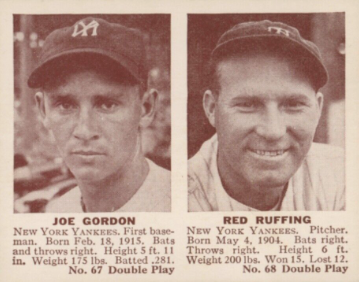
1941 Play Ball #67
1949 Bowman #210
1950 Bowman #129
1960 Topps #216
1961 Topps #224

Other Notable Baseball Cards

First Mainstream Card:  1939 Goudey Premiums
Topps Flagship Set Appearances (3):  1960-61, 1969
Most Recent Mainstream Card:  2008 Upper Deck Yankee Stadium Legacy #1629
Total Non-Parallel Baseball Cards:  166 in the Beckett online database as of 11/29/24.

Update Cards
For my 1965 Topps blog, I used the team card posts to come up with five or six candidates per team for an imaginary update series.  With no team cards in the 1969 Topps set, I'll use each manager card for this exercise, and come up with a list of deserving cards to be included in an 8th/update series.  There are four Rookie Stars cards for the Royals in the set, featuring 10 different players, and I had to limit which players received solo cards in my update set.  Still, I went a few cards over my limit here.
  • Lou Piniella (lf) - Piniella is on a Pilots Rookie Stars card, but I'd give him a Royals solo card in my update set.
  • Bob Oliver (cf) - Oliver gets his own card in my set too.
  • Pat Kelly (rf) - Rounding out the starting outfield, right fielder Pat Kelly (#619) is deserving of his own card.
  • Ellie Rodriguez (c) - Catcher Ellie Rodriguez (#49) and first baseman Mike Fiore (#376) are the fourth, fifth and final of the starting eight who appeared on Rookie Stars cards in the regular set.
  • Mike Fiore (1b)
  • Buck Martinez (c) - Back-up catcher Buck Martinez is the only one listed here not already in the main set in some form.  He'd get his rookie card in the 1970 Topps set.
  • Dick Drago (rhp) - Drago is the only pitcher I'm giving a solo card to, although Bill Butler (#619) and Jim Rooker (#376) are both deserving candidates.
Sources:  
Baseball Reference - Gordon / Baseball Reference - 1969 Royals / SABR / Wikipedia

Tuesday, April 11, 2023

#633 Harry Walker MG - Houston Astros


Harry William Walker
Houston Astros

Manager

Bats:  Left  Throws:  Right  Height:  6'2"  Weight:  175
Born:  September 22, 1918, Pascagoula, MS
Signed:  Signed by the Philadelphia Phillies as an amateur free agent before 1937 season
Major League Teams:  St. Louis Cardinals 1940-1943, 1946-1947; Philadelphia Phillies 1947-1948; Chicago Cubs 1949; Cincinnati Reds 1949; St. Louis Cardinals 1950-1951, 1955
World Series Appearances:  St. Louis Cardinals 1942-1943, 1946
As a Manager:  St. Louis Cardinals 1955; Pittsburgh Pirates 1965-1967; Houston Astros 1968-1972
Died:  August 8, 1999, Birmingham, AL (age 80)

Harry "The Hat" Walker starred for the Cardinals in the 1940s and missed two seasons in his prime while serving in the military.  Before and after his military service, he helped lead the Cardinals to two World Series titles in 1942 and 1946.  He hit .412 (7 for 17) in the 1946 World Series and drove home the winning run with an RBI double in the decisive Game 7 against the Red Sox.  Traded to the Phillies in May 1947, he won the National League batting title with a .363 average and also led the league with a .436 OBP.  He appeared in the 1943 and 1947 All-Star Games and finished his 11 year career with a .296 average and 786 hits.  His brother Dixie Walker was a four-time All-Star with the Dodgers in the 1940s, and his father, the elder Dixie Walker, played for the Senators between 1909 and 1912.

Walker started his big league managerial career as a player-manager for the Cardinals in mid-1955, replacing the fired Eddie Stanky.  He was let go as Cardinals manager following the season, but he remained with the organization as a minor league manager and a coach for the club between 1959 and 1962.  As Pirates manager between 1965 and 1967, he had his most success the first two seasons, leading the club to third place finishes in the N.L.  He'd later manage the Astros for five seasons.  In parts of nine seasons as a manager in the Majors, Walker compiled a record of 630-604.

Some text for this post originally appeared on my 1965 Topps blog.

Building the Set / Card #64
January 17, 2023 from Greg Morris Cards - Los Angeles, CA
On the evening of January 8th, I found myself sitting in Terminal C of the Philadelphia International Airport waiting to board my flight to Dallas.  Earlier that day, I had enjoyed watching our oldest son Doug at a winter track meet as he pole vaulted for his high school.  I was in a good mood despite the the fact that like most flights that day, my flight had been delayed.  This was for a work trip, and I was doing my best to stay positive and keep myself in the post-holiday happiness hangover that had lingered into the year's second week.  eBay seller Greg Morris Cards, based out of Los Angeles, somehow seems to post cards from various vintage baseball card set breaks on a weekly basis, with the cards typically all in fantastic condition.  With time to kill, knowing that bidding on baseball cards was a surefire good mood sustainer, and having only 40 cards so far for our 1969 Topps set, I pleasantly passed the time by bidding on 62 commons, all with no previous bidders, and all ending within the next 30 hours.

The next afternoon, while on a break at our work conference in the Hilton Anatole, I checked on the auctions, noting I had been outbid on a few, but was still the high bidder for most of the 62 cards.  That night, as auctions were close to ending, and as I was enjoying a few adult beverages at the fine Rodeo Goat establishment across the street from the Hilton, my Apple Watch began vibrating every few seconds as I was outbid on dozens of auctions.  When the dust had settled, I had won 24 new cards at an average price of about $2.50 per card.  This Walker card, the last of the bunch, was $2.70, and arrived a week after I had made the return trip home from Dallas.

The Card / Astros Team Set / Accuracy Index -8
Walker is clearly wearing a Pirates uniform here.  The back of the card needs a little explaining, as Walker didn't begin his major league managerial career until 1955.  In 1951, Walker was named player-manager of the Triple-A Columbus Red Birds.  The team would finish with a 53-101 record, but Walker took home the league batting title with an impressive .393 average.  He'd be promoted to manage the Cardinals' Triple-A club in 1952.

Accuracy Index:  Walker receives what's becoming a standard -8, for being pictured in the Pirates uniform (-5) and having a logo-less hat (-3).

1969 Season
Walker led the Astros to their first non-losing season, breaking even with an 81-81 record and a fifth place finish in the National League West.  Center fielder Jim Wynn (#360) was the team's top slugger, batting .269 with 33 home runs and 87 RBIs.  Shortstop Denis Menke (#487) led the team with 90 RBIs.

The trio of Larry Dierker (#411), Don Wilson (#202) and Tom Griffin (#614) each had at least 200 strikeouts, and the 1,221 strikeouts in total from the Astros' pitching staff set a record that would stand until broken by the 1996 Braves.  Closer Fred Gladding (#58) converted 29 saves to lead the National League.

Phillies Career
Walker was originally signed by the Phillie before the 1937 season, but then sent to the Cardinals before the 1940 season in what Baseball Reference calls an "unknown transaction."  His SABR biography notes he was signed by the Indians, and not the Phillies.  In any event, on May 3, 1947, the Cardinals traded him to the Phillies with Freddy Schmidt for Ron Northey.  Walker earned his second All-Star game nod in 1947 and he started in center field and led off for the N.L.  His brother Dixie batted second and played right field.

His Phillies career lasted through the 1948 season as he was traded to the Cubs on October 4, 1948 for Bill Nicholson.  In 242 games with the Phillies, Walker hit .339.

1949 Bowman #130
1960 Topps #468
1967 Topps #448
1970 Topps #32
1972 Topps #249

Other Notable Baseball Cards

First Mainstream Card:  1949 Bowman #130
Topps Flagship Set Appearances (8):  1960, 1965-1967, 1970-1972
Most Recent Mainstream Card:  2018 Panini Diamond Kings #45
Total Non-Parallel Baseball Cards:  81 in the Beckett online database as of 2/13/23.

Update Cards
For my 1965 Topps blog, I used the team card posts to come up with five or six candidates per team for an imaginary update series.  With no team cards in the 1969 Topps set, I'll use each manager card for this exercise, and come up with a list of deserving cards to be included in an 8th/update series.
  • Jesus Alou (lf) - Jesus Alou (#22) and Jack Billingham (#92) came over from the Expos in the deal that sent one of the franchise's first stars, Rusty Staub (#230), to the new expansion team.  Both Alou and Billingham have Expos cards in the set.
  • Jack Billingham (rhp)
  • Tom Griffin (rhp) - Tom Griffin shares a Rookie Stars card (#614) with Skip Guinn in the set, but I'd give him his own card in the update set.
  • Jim Bouton (rhp) - Bouton would pitch in 45 games for the Astros in 1969 and 1970, but never appear on an Astros card in a Topps set.
  • Sandy Valdespino (lf) - The outfielder last appeared in a Topps set in 1968, but he appeared in 41 games for the Astros in 1969.
  • J.R. Richard (rhp) - The future star was the Astros' 1st round pick (second overall) in the 1969 amateur player draft.  It's a stretch, but I'd give him a card in an imaginary 8th series.
Sources:  
Baseball Reference - Walker / Baseball Reference - 1969 Astros / SABR

Tuesday, March 14, 2023

#91 Al Dark MG - Cleveland Indians


Alvin Ralph Dark
Cleveland Indians

Manager

Bats:  Right  Throws:  Right  Height:  5'11"  Weight:  185
Born:  January 7, 1922, Comanche, OK
Signed:  Signed by the Boston Braves as an amateur free agent, July 4, 1946
Major League Teams:  Boston Braves 1946, 1948-1949; New York Giants 1950-1956; St. Louis Cardinals 1956-1958; Chicago Cubs 1958-1959; Philadelphia Phillies 1960; Milwaukee Braves 1960
World Series Appearances:  Boston Braves 1948; New York Giants 1951, 1954; San Francisco Giants 1962; Oakland Athletics 1974
As a Manager:  San Francisco Giants 1961-1964; Kansas City Athletics 1966-1967; Cleveland Indians 1968-1971; Oakland Athletics 1974-1975; San Diego Padres 1977
Died:  November 13, 2014, Easley, SC (age 92)

Al Dark spent 27 years in the majors first as an All-Star shortstop between 1946 and 1960 and then as a successful manager between 1961 and 1977.  Dark was the National League Rookie of the Year in 1948, batting .322 with 48 RBIs.  He was a three-time All-Star (1951, 1952 and 1954) and earned MVP votes in six different seasons.  Dark led the league in doubles with 41 in 1951, the year he helped the Giants reach the World Series.  He'd have to wait until 1954 to win his first World Series ring when he batted .412 during the series while helping the Giants sweep the Indians.  Dark finished eight seasons in the top five for fielding percentage among all National League shortstops and he led the league in double plays turned three times.  In 1,828 career games, Dark batted .289 with 126 home runs and 2,089 hits.

After retiring as a player, Dark began his managerial career with the Giants in 1961, guiding the team to the National League pennant in 1962.  After stints with the Kansas City Athletics and Indians, Dark took over the Oakland Athletics in 1974 and led the team to its third straight World Series.  (The team had won in 1972 and 1973 with Dick Williams (#349) as the manager.)  He was 994-954 as a manager, just missing the 1,000-win plateau.

Some text for this post originally appeared on my 1956 Topps blog.

Building the Set / 
Card #44
January 17, 2023 from Greg Morris Cards - Los Angeles, CA
On the evening of January 8th, I found myself sitting in Terminal C of the Philadelphia International Airport waiting to board my flight to Dallas.  Earlier that day, I had enjoyed watching our oldest son Doug at a winter track meet as he pole vaulted for his high school.  I was in a good mood despite the the fact that like most flights that day, my flight had been delayed.  This was for a work trip, and I was doing my best to stay positive and keep myself in the post-holiday happiness hangover that had lingered into the year's second week.  eBay seller Greg Morris Cards, based out of Los Angeles, somehow seems to post cards from various vintage baseball card set breaks on a weekly basis, with the cards typically all in fantastic condition.  With time to kill, knowing that bidding on baseball cards was a surefire good mood sustainer, and having only 40 cards so far for our 1969 Topps set, I pleasantly passed the time by bidding on 62 commons, all with no previous bidders, and all ending within the next 30 hours.

The next afternoon, while on a break at our work conference in the Hilton Anatole, I checked on the auctions, noting I had been outbid on a few, but was still the high bidder for most of the 62 cards.  That night, as auctions were close to ending, and as I was enjoying a few adult beverages at the fine Rodeo Goat establishment across the street from the Hilton, my Apple Watch began vibrating every few seconds as I was outbid on dozens of auctions.  When the dust had settled, I had won 24 new cards at an average price of about $2.50 per card.  This Dark card was $4, and arrived a week after I had made the return trip home from Dallas.

The Card / Indians Team Set / Accuracy Index -8
Dark is wearing a Giants uniform here, a team he last managed in 1964.  Topps had more recent photos of the veteran manager in an Athletics uniform, but this photo was selected as the dark colors more closely approximated an Indians jersey.  The back of the card highlights his World Series heroics.  Dark's .323 average was a result of him going 21 for 65 in the 1948, 1951 and 1954 World Series.  Topps goes with Al for the front, but Alvin on the back.

Accuracy Index:  Dark loses 5 points for the Giants jersey and another 3 points for having his hat logo blacked out.

1969 Season
Dark managed for parts of 13 seasons in the majors, and this was by far the worst.  His Indians team went 62-99 to finish in sixth place in the American League East, 46 1/2 games behind the Orioles.  First baseman Tony Horton took the team Triple Crown by batting .278 with 27 home runs and 93 RBIs.  Right fielder Ken Harrelson (#240) also had 27 home runs.  Sam McDowell (#220) went 18-14 with a 2.94 ERA, 18 complete games and four shutouts.

Phillies Career
Dark came to the Phillies in the trade that saw popular Phillie and future Hall of Famer Richie Ashburn (depart the franchise.  On January 11, 1960, the Phillies acquired Dark, John Buzhardt and Jim Woods from the Cubs for Ashburn.  With Dark at 38, only Dave Philley was older on the club at 40.  Dark was the Phillies' opening day third baseman in 1960 and he was a regular in the line-up until the team traded him on June 23rd to the Braves for Joe Morgan.

His first hit of the season in the team's home opener on April 14th was the 2,000 of his career, a sixth inning infield single off pitcher Don McMahon (#616).  With the Phillies, Dark hit .242 over 55 games, with 3 home runs and 14 RBIs.  His short time with the club earned him a 1960 Topps card, released late in the season.

1949 Bowman #67
1951 Bowman #14
1960 Topps #472
1970 Topps #524
1978 Topps #467

Other Notable Baseball Cards

First Mainstream Card:  1949 Bowman #67
Topps Flagship Set Appearances (19):  1952-1953, 1956-1964, 1966-1970, 1975, 1978
Most Recent Mainstream Card:  2011 Topps Lineage Autographs #RA-AD
Total Non-Parallel Baseball Cards:  139 in the Beckett online database as of 1/30/23.

Update Cards
For my 1965 Topps blog, I used the team card posts to come up with five or six candidates per team for an imaginary update series.  With no team cards in the 1969 Topps set, I'll use each manager card for this exercise, and come up with a list of deserving cards to be included in an 8th/update series.  I cut the list off at seven for the Indians, although I could have easily added a few more.
  • Tony Horton (1b) - Horton played in seven seasons, with the Indians and Red Sox, and never received a Topps baseball card.  He was the Indians' regular first baseman in 1969, appearing in 159 games.
  • Ken Harrelson (rf) - Harrison and Pizarro were acquired from the Red Sox on April 19th.
  • Juan Pizarro (lhp) - Like Harrelson, Pizarro (#498) has a card in the set with the Red Sox.
  • Lou Klimchock (3b) - The team's most regularly used third baseman was omitted from the set.
  • Zoilo Versalles (inf) - The Indians' opening day third baseman, the former MVP is in the set with the expansion Padres (#38), but he'd be traded to Cleveland before ever putting on a Padres uniform.
  • Frank Baker (lf) - The Indians used nine different starting left fielders in 1969, with Baker topping them all with 44 starts.  His rookie card is in the 1970 Topps set.
  • Ron Law (rhp) - Law's only major league action came in 1969 when he pitched in 35 games for the Indians.  He never appeared in a Topps set.
Sources:  
Baseball Reference - Dark / Baseball Reference - 1969 Indians / SABR / Wikipedia